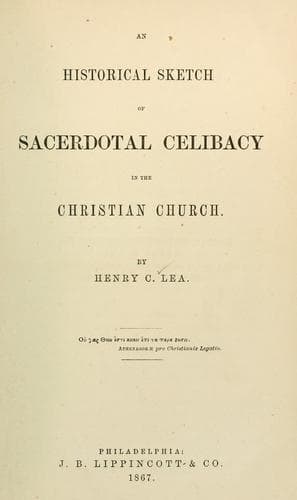
An Historical Sketch of Sacerdotal Celibacy in the Christian ChurchLea, Henry Charles
History
An Historical Sketch of Sacerdotal Celibacy in the Christian Church
Lea, Henry Charles
Catholic Church -- Clergy; Celibacy -- Catholic Church; Church history
of affairs continued until the sixteenth century was well advanced.
XX.
GENERAL LEGISLATION.
In a former section we have seen the efforts made by Calixtus II. to
enforce the received discipline of the church, and we have noted the
scanty measure of success which attended his labors. He apparently
himself recognized that they were futile, and that some action of
more decided character than had as yet been attempted was necessary
to accomplish the result so long and so energetically sought, and
so illusory to its ardent pursuers. On his return to Italy, and his
triumph over his unfortunate rival, the anti-pope Martin Burdino, he
summoned, in 1123, the first general council of the West, to confirm
the Concordat of Worms, which had just closed half a century of strife
between the papacy and the empire. Nearly a thousand prelates obeyed
his call, and that august assembly promulgated a canon which not only
forbade matrimony to those bound by vows and holy orders, but commanded
that if such marriages were contracted they should be broken, and the
parties to them subjected to due penance.[779]
This was a bold innovation. With the exception of a decretal of Urban
II. in 1090, to which little attention seems to have been paid, we have
seen that, previous to Calixtus, while the sacrament of marriage was
held incompatible with the ministry of the altar and with the enjoyment
of church property, it yet was respected and its binding force was
admitted, even to the point of rendering those who assumed it unfitted
for their sacred functions. At most, and as a concession to a lax and
irreligious generation, the option was allowed of abandoning either
the wife or the church. At Rheims, Calixtus had deprived them of this
choice, and had ordered their separation from their wives. He now went
a step further, and by the Lateran canon he declared the sacrament
of marriage to be less potent than the religious vow: the engagement
with the church swallowed up and destroyed all other ties. This gave
the final seal to the separation between the clergy and the laity, by
declaring the priestly character to be indelible. When once admitted
to orders, he became a being set apart from his fellows, consecrated
to the service of God; and the impassable gulf between him and the
laity bound him forever to the exclusive interests of the church.
It is easy to perceive how important an element this irrevocable
nature of sacerdotalism became in establishing and consolidating the
ecclesiastical power.
The immensity of the change thus wrought in the practice, if not in
the doctrine, of the church can best be understood by comparing the
formal command thus issued to the Christian world with the unqualified
condemnation pronounced in earlier times against those who attempted to
dissolve marriage under religious pretexts.[780] And in all ages the
church has regarded the chastity of the monastic orders as even more
imperative than that of the secular clergy.
Public-domain text, read in full here on John Shaqi.
Reviews
Reviews
No reviews yet
Be the first to share your thoughts on this work.
Elsewhere in the archive