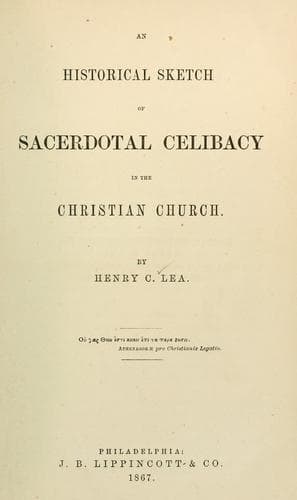
An Historical Sketch of Sacerdotal Celibacy in the Christian ChurchLea, Henry Charles
History
An Historical Sketch of Sacerdotal Celibacy in the Christian Church
Lea, Henry Charles
Catholic Church -- Clergy; Celibacy -- Catholic Church; Church history
Revolutions never go backwards. Perhaps the Lateran fathers who adopted
the canon scarcely realized its logical conclusions. If they did,
they at all events shrank from expressing them openly and fully, and
left the faithful to draw their own deductions as to the causes and
consequences of such an order. Time, however, familiarized the minds of
ardent churchmen with the idea, and it was seen that if the practice
thus enjoined was correct, doctrine must be made to suit and to justify
it. To this end an additional stimulus was afforded by the failure of
the canon to accomplish the results anticipated from it, for the custom
of sacerdotal marriage was as yet by no means eradicated. The council
of Liége, held by Innocent II. in 1131, referred to in a preceding
section, and those of Clermont and Rheims, over which he likewise
presided, in 1130 and 1131, show how little had been accomplished,
and how generally the clergy of Europe disregarded the restrictions
nominally imposed upon them, and the punishments which they so
easily escaped.[781] In the canons of these councils not only is it
observable that the question of marriage and celibacy is treated as
though it were a matter now for the first time brought to the attention
of the clergy, but also that the innovation attempted by the council of
Lateran, only seven or eight years previous, is prudently suppressed
and passed over without even an allusion.
* * * * *
Innocent, restored to Rome and to power, was bolder than when wandering
through Europe, soliciting the aid of the faithful. Surrounded by a
thousand bishops at the second great council of Lateran, in 1139, he
no longer dreaded to offend the susceptibilities of the clergy, and he
proceeded to justify the canon of 1123 by creating a doctrine to suit
the practice there enjoined. After repeating the canons of Clermont
and Rheims, he unhesitatingly pronounced that a union contracted in
opposition to the rule of the church was not a marriage.[782] He draws
no argument from the conflict of sacraments assumed to be incompatible;
a simple vow dissolves the sacrament of marriage, and renders it null
and void—or rather destroys its efficacy and anticipates its existence.
Public-domain text, read in full here on John Shaqi.
Reviews
Reviews
No reviews yet
Be the first to share your thoughts on this work.
Elsewhere in the archive
Join the Discussion
Join the discussion
Sign in to leave a comment or review.
Sign InorCreate an account