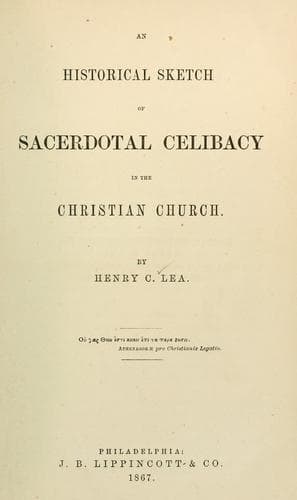
An Historical Sketch of Sacerdotal Celibacy in the Christian ChurchLea, Henry Charles
History
An Historical Sketch of Sacerdotal Celibacy in the Christian Church
Lea, Henry Charles
Catholic Church -- Clergy; Celibacy -- Catholic Church; Church history
The abounding wickedness of a perverse generation caused this decree
of the loftiest Christian tribunal to fall still-born and abortive as
its forerunners had done.[783] The church, however, was irrevocably
committed to the new doctrine and to all its consequences. When
Eugenius III. was driven out of Rome by Arnold of Brescia, he presided,
in 1148, over a council held at Rheims, where eleven hundred bishops
and abbots from Northern and Western Europe assembled to do honor
to the persecuted representative of St. Peter, and to condemn the
teachings of Gilbert de la Porrée. From this great assembly he
procured the confirmation of the new dogma by their adoption of the
Lateran canon; while the repetition of that of Clermont and Rheims (of
1130 and 1131) shows that the evil which it was intended to repress
still existed in full force.[784] The vague assertion of Eugenius
that he was but following in the footsteps of the holy fathers, and a
special reference to Innocent II. as his authority, render it probable
that the members of the council demurred in committing themselves to
the new principle, and that it was only by showing that the matter was
already decided under the irrefragable authority of a general council
that the consent of the Transalpine churches was obtained.
St. Bernard himself, the impersonation of ascetic sacerdotalism,
hesitated to subscribe to the new dogma, and when the monks of
Chartres asked him to reconcile it with the teachings of Augustin
and Gregory the Great he candidly confessed that his dialectical
skill was unequal to the task.[785] So when an abbot applied to him
for advice in the case of one of his monks, who had left the convent
and married, St. Bernard stigmatized the act as highly improper, but
hesitated to pronounce it unlawful. He recommended that an attempt be
made to convince the parties that they were perilling their salvation,
and if this failed he thought that perhaps they might be separated
by episcopal authority.[786] In fact, four years after the council
of Rheims, St. Bernard reproached Eugenius with having caused the
adoption of canons which no one pretended to obey. If he thought that
they were enforced, he grievously erred; if he did not think so, he
had sinned either by decreeing what was not to be observed or in
neglecting to punish their non-observance—and no one was punished for
his disobedience.[787]
Public-domain text, read in full here on John Shaqi.
Reviews
Reviews
No reviews yet
Be the first to share your thoughts on this work.
Elsewhere in the archive
Join the Discussion
Join the discussion
Sign in to leave a comment or review.
Sign InorCreate an account