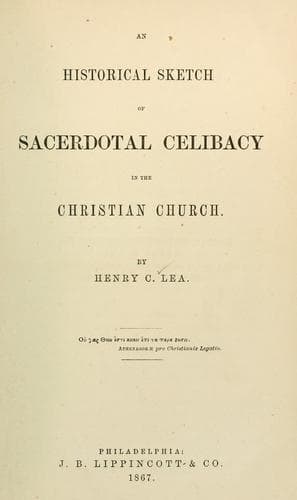
An Historical Sketch of Sacerdotal Celibacy in the Christian ChurchLea, Henry Charles
History
An Historical Sketch of Sacerdotal Celibacy in the Christian Church
Lea, Henry Charles
Catholic Church -- Clergy; Celibacy -- Catholic Church; Church history
Even in Rome itself the point was still disputed. At that very
time Gratian, the greatest canonist of the age, was engaged in
the compilation of his “Concordia discordantium Canonum,” a work
undertaken at the request of the papal curia to restore to the canon
law the preëminence which it was fast losing in consequence of the
recently revived study of the Justinian jurisprudence. Published in
1151 under the auspices of Eugenius himself, and presented to the world
as the authoritative exposition of the laws and discipline of the
church, it was everywhere received with acclamation, and has remained
to this day the foundation of the canon law. Yet Gratian himself, in
this work without appeal, distinctly declares his opposition to the
doctrine of Innocent and Eugenius, asserting that a deacon can lawfully
marry if he chooses to abandon the ministry, and that the sacrament of
marriage is so potent that no antecedent vow can render it void.[788]
The new law was long in winning its way to general respect, nor can it
be a subject of wonder if those who disregarded the acknowledged canons
of the church by marrying in orders, or by permitting such marriages in
those under their charge, should neglect a rule of recent origin and of
more than doubtful propriety. The church, however, was committed to it,
and, moreover, could see in its eventual recognition a more effectual
means of accomplishing the long desired object than in any expedient
previously tried. By destroying all such marriages, pronouncing them
null and void, inflicting an ineffaceable stigma on wife and offspring,
subjecting the woman to the certainty of being cast off without
resource and without option on the part of the husband, the position of
the wife of an ecclesiastic would become most unenviable; her kindred
would prevent her from exposing herself to such calamities, and no
priest could succeed in finding a consort above the lowest class, whose
union with him would expose him to the contempt of his flock.
Public-domain text, read in full here on John Shaqi.
Reviews
Reviews
No reviews yet
Be the first to share your thoughts on this work.
Elsewhere in the archive
Join the Discussion
Join the discussion
Sign in to leave a comment or review.
Sign InorCreate an account