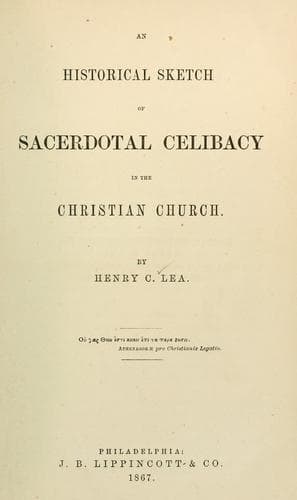
An Historical Sketch of Sacerdotal Celibacy in the Christian ChurchLea, Henry Charles
History
An Historical Sketch of Sacerdotal Celibacy in the Christian Church
Lea, Henry Charles
Catholic Church -- Clergy; Celibacy -- Catholic Church; Church history
How slender was the immediate result of the efforts of Innocent and
Eugenius, however, is manifested by the allusions of Geroch, Provost
of Reichersperg, who, writing about the middle of the century,
complains that any one who would shun intercourse with Nicolitan and
simoniacal heretics must quit the world, for it was full of them, and
he maintains the propriety of calling them heretics because they openly
defended and justified their evil courses.[789] Indeed, so shamelessly
were their transgressions displayed, that the faithful were sometimes
scandalized by the sight of the priests’ wives assisting their husbands
in the ministry of the altar;[790] while conventual discipline had
sunk so low that nuns were in the habit of deferring their formal vows
until the lassitude of old age should render the restraints thereby
assumed easy to be endured,[791] and canons led a life which was only
distinguishable from that of the laity by its shamelessness.[792] Nor
was this confined to Germany. In France, Hugh, Archbishop of Rouen,
complains that those who married in orders openly defended their evil
practices and quoted Scripture to sustain themselves.[793]
In England, as seen in a preceding section, the new theory of Innocent
and Eugenius remained a dead letter. Indeed, as late as 1470 Sir John
Fortescue incidentally alludes to a recent case in which a priest named
John Fringe, who had lived in orders for three years, procured two
false witnesses to swear that he had previously been betrothed to a
certain maiden, and this preliminary promise of marriage was held by
court to supersede his priestly ordination; he was ejected from the
priesthood and compelled to marry the girl, with whom he lived fourteen
years, until he was executed for treason by the Lancastrians during the
wars of the Roses.[794] In Spain, as we have already seen, priestly
marriage was forbidden by the secular law as late as the latter half
of the thirteenth century, and priests in consequence were wont to
protect their partners by entering into the most solemn compacts, the
customary employment of which shows that they must have been habitually
enforced by the municipal tribunals regardless of the censures of the
church.
* * * * *
Public-domain text, read in full here on John Shaqi.
Reviews
Reviews
No reviews yet
Be the first to share your thoughts on this work.
Elsewhere in the archive
Join the Discussion
Join the discussion
Sign in to leave a comment or review.
Sign InorCreate an account