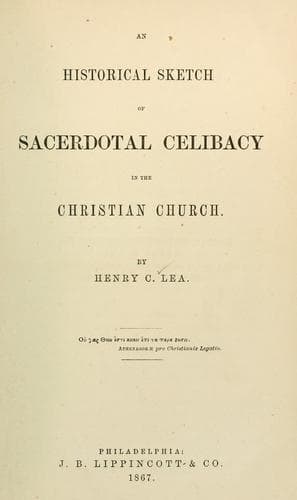
An Historical Sketch of Sacerdotal Celibacy in the Christian ChurchLea, Henry Charles
History
An Historical Sketch of Sacerdotal Celibacy in the Christian Church
Lea, Henry Charles
Catholic Church -- Clergy; Celibacy -- Catholic Church; Church history
The long pontificate of Alexander III., extending from 1159 to 1181,
was absorbed for the most part by his deadly strife with Frederic
Barbarossa. Yet, even before he was released from that ever-present
danger, he found leisure to urge the cause of sacerdotal celibacy; and
after the humiliation of his mortal enemy he devoted himself to it
with a zeal which earned for him among his contemporaries the credit
of establishing its observance.[795] He who, as the legate Roland,
had nearly paid, under the avenging sword of Otho of Wittelsbach, the
forfeit of his life for his rude boldness at the imperial court, was
little likely to abate one jot of the claims which the church asserted
on the obedience of layman and clerk; and he recognized too fully the
potency of the canons of Lateran and Rheims not to insist upon their
observance. The very necessity under which he found himself, however,
of repeating those canons shows how utterly neglected they had been,
and how successfully the clergy had thus far resisted their reception
and acknowledgment. Thus when, in 1163, he held the council of Tours,
he was obliged to content himself with a canon which allowed three
warnings to those who publicly kept concubines, and it was only after
neglect of these warnings that they were threatened with deprivation of
functions and benefice;[796] and when, in 1172, his legates presided
over the council of Avranches, which absolved Henry II. for the murder
of A’Becket, the Norman clergy were emphatically reminded that those
who married in holy orders must put away their wives, and this in terms
which indicate that the rule had not been previously obeyed.[797]
Yet notwithstanding this formal declaration, only a few years later
we find the Archbishop of Rheims applying to him for counsel in the
case of a deacon who had committed matrimony, to which Alexander
of course replied that the marriage was no marriage, and that the
offending ecclesiastic must be separated from the woman, and undergo
due penance.[798] The persistence of the pope, and the necessity
of his urgency, are farther shown by sundry epistles to various
English bishops, in which the rule is enunciated as absolute and
unvarying;[799] and he takes occasion to stigmatize such marriages with
the most degrading epithet, when he graciously pardons those concerned,
and permits their restitution after a long course of penitence, on
their giving evidence of a reformed life.[800]
Public-domain text, read in full here on John Shaqi.
Reviews
Reviews
No reviews yet
Be the first to share your thoughts on this work.
Elsewhere in the archive
Join the Discussion
Join the discussion
Sign in to leave a comment or review.
Sign InorCreate an account