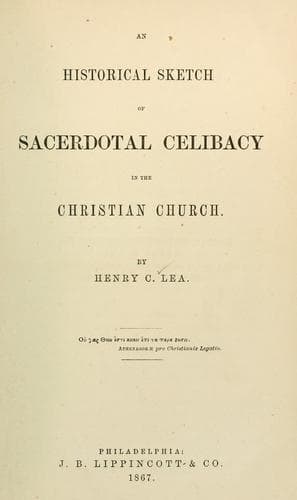
An Historical Sketch of Sacerdotal Celibacy in the Christian ChurchLea, Henry Charles
History
An Historical Sketch of Sacerdotal Celibacy in the Christian Church
Lea, Henry Charles
Catholic Church -- Clergy; Celibacy -- Catholic Church; Church history
A single instance, out of many that might be cited, will illustrate
this. In 1225 the Cardinal-legate Conrad held, at Mainz, a national
council of the German empire, of which one of the canons declared
that, in order to abolish the custom of ecclesiastics leaving to
their concubines and children the fruits of their benefices, not only
should such legacies be void, but those guilty of the attempt should
lie unburied, all who endeavored to enforce such testaments should be
anathematized, and the church where it was permitted should lie under
an interdict as long as the wrong was permitted.[845] The terrible
rigor of these provisions shows how deep seated was the evil aimed at;
nor were they uncalled for when we see a will, executed in 1218 by no
less a personage than Gotfrid, Archdeacon of Wurzburg, in which he
leaves legacies to the children whom he confesses to have been born in
sin, and of whom he expects his relatives to take charge.[846] Had any
earnest attempt been made to enforce the canons of the Legate, they
would have been amply sufficient to eradicate the evil; yet their utter
inefficiency is demonstrated by the council of Fritzlar in 1246, and
that of Cologne in 1260. The former of these was held by the Archbishop
of Mainz; it has no canons directed against concubinage, which was as
public as ever, but it deplores the dilapidation of the temporalities
of the church by the testamentary provisions of priests in favor of
their guilty partners and children, and it repeats, with additional
emphasis, the regulations of 1225.[847] The latter renews the complaint
that priests not only continue their evil courses throughout life,
but are not ashamed, on their death-beds, to leave to their children
the patrimony of Christ; and another provision is equally significant
in forbidding priests to be present at the marriages of their
children, or that such marriages should be solemnized with pomp and
ostentation.[848] The following year another council, held at Mainz,
repeated the prohibition as to the diversion of church property to the
consorts and natural children of priests;[849] while that regarding the
solemnization of their children’s marriages was renewed by the synod of
Olmutz in 1342.[850] In 1416 the synod of Breslau deplored that the old
canons were forgotten and despised, and that priests were not ashamed
to bequeath to their bastards accumulations of property which would
form fit portions for lofty nobles.[851] How thoroughly in fact it was
deemed a matter of course for the children of ecclesiastics to marry
well and to have good dowries, is to be seen in Chaucer’s description
of the wife of “deinous Simekin”, the proud miller of Trompington:——
“A wif he hadde, comen of noble kin;
The person of the toun hire father was.
With hire he yaf ful many a panne of bras,
For that Simkin shuld in his blood allie.
She was yfostered in a nonnerie.” (The Reves Tale.)
Public-domain text, read in full here on John Shaqi.
Reviews
Reviews
No reviews yet
Be the first to share your thoughts on this work.
Elsewhere in the archive
Join the Discussion
Join the discussion
Sign in to leave a comment or review.
Sign InorCreate an account