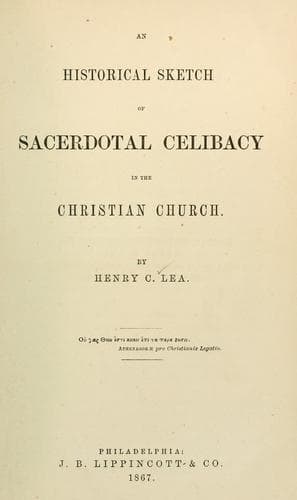
An Historical Sketch of Sacerdotal Celibacy in the Christian ChurchLea, Henry Charles
History
An Historical Sketch of Sacerdotal Celibacy in the Christian Church
Lea, Henry Charles
Catholic Church -- Clergy; Celibacy -- Catholic Church; Church history
As time wore on, and the clergy, despite the innumerable admonitions
and threats which were everywhere showered upon them, persisted in
retaining their female companions, they appear, in some places, to
have gradually assumed the privilege as a matter of right; and, what
is even more remarkable, they seem to have had a certain measure of
success in the assumption. In 1284 the Papal Legate, Gerard Bishop
of Sabina, at the Council of Amalfi, renewed and strengthened the
decretals of Alexander III. respecting the concubinary priests of the
Neapolitan provinces, ordering the ejection of all who should not
separate from their partners within a month, suspending all prelates
who should neglect to enforce the rule, and fining heavily those who,
as in so many other places, made the frailties of their subordinates
a source of filthy gain.[852] The severity of these provisions was as
unsuccessful as usual, and at length the secular power endeavored to
come to the assistance of the ecclesiastical authorities. The pious
Charles the Lame of Naples, whose close alliance with Rome rendered
him eager in everything that would gratify the head of the church,
about the year 1300 imposed a heavy fine on the concubines of priests
if they persisted in their sin for a year after excommunication. This
law, like so many similar ones, soon fell into desuetude, but in 1317,
under his son Robert the Good, the justiciary of the Principato Citra
undertook to put it into execution. In the diocese of Marsico the
clergy openly resisted these proceedings, boldly laid their complaints
before the king, and were so energetic that Robert was obliged to issue
an ordinance directing the discontinuance of all processes before the
lay tribunals, and granting that the concubines should be left to the
care of the ecclesiastical courts alone. These women thus, by reason of
their sinful courses, came to be invested with a quasi-ecclesiastical
character, and to enjoy the dearly prized immunities attached to that
position, at a time when the church was vigorously striving to uphold
and extend the privileges which the civil lawyers were systematically
laboring to undermine. Nor was the pretension thus advanced suffered to
lapse. Towards the close of the same century, Carlo Malatesta of Rimini
applied to Ancarono, a celebrated doctor of canon and civil law (“juris
canonici speculum et civilis anchora”), to know whether he could
impose penalties on the concubines of priests, and the learned jurist
replied decidedly in the negative; while other legal authorities have
not hesitated to state that such women are fully entitled to immunity
from secular jurisdiction, as belonging to the families of clerks—_de
familia clericorum_.[853] When a premium was thus offered for sin,
and the mistresses of priests—like the _maîtresses-en-titre_ of the
Bourbons—acquired a certain honorable position among their fellows from
the mere fact of their ministering to the unhallowed lusts of their
Public-domain text, read in full here on John Shaqi.
Reviews
Reviews
No reviews yet
Be the first to share your thoughts on this work.
Elsewhere in the archive
Join the Discussion
Join the discussion
Sign in to leave a comment or review.
Sign InorCreate an account