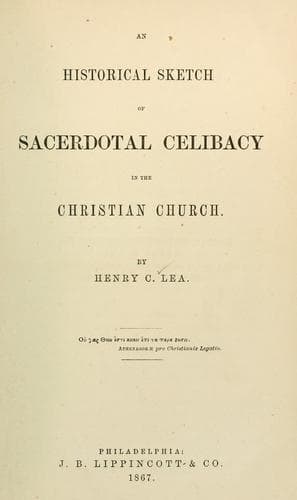
An Historical Sketch of Sacerdotal Celibacy in the Christian ChurchLea, Henry Charles
History
An Historical Sketch of Sacerdotal Celibacy in the Christian Church
Lea, Henry Charles
Catholic Church -- Clergy; Celibacy -- Catholic Church; Church history
pastors, it is not to be wondered at if such connections multiplied
and flourished, and if the humble laity came to regard them as an
established institution.
Robert of Naples was not the only potentate who found an organized
resistance to his well-meant endeavors to restore discipline. When, in
1410, the stout William, Bishop-elect of Paderborn, had triumphed with
fire and sword over his powerful foes, the Archbishop of Cologne and
the Count of Cleves, he turned his energies to the reformation of the
dissolute morals of his monks. They positively refused to submit to the
ejection of their women from the monasteries, and he at length found
the task too impracticable even for his warlike temper. For seven long
years the quarrel lasted, legal proceedings being varied by attempts
at poison on the one side, and reckless devastations by the episcopal
troops on the other, until the prelate, worn out by the stubbornness of
his flock, was obliged to give way.[854]
Equal success waited on the resistance of the Swiss clergy when, in
1230, the civil authorities of Zurich sacrilegiously ordered them to
dismiss their women. They resolutely replied that they were flesh
and blood, unequal to the task of living like angels, and unable to
attend to the kitchen and other household duties. The townsmen entered
into a league against them, and succeeded in driving away some of the
sacerdotal consorts, when the Bishop of Constance and his chapter,
allowing perhaps the pride of the churchman to get the better of
ascetic zeal, interfered with a threat of excommunication on all who
should presume to intervene in a matter which related specially to the
church. He absolved the leaguers from the oaths with which they were
mutually bound, and thus restored security to the priestly households.
About the same time Gregory IX. appointed a certain Boniface to the
see of Lausanne. On his installation, the new bishop commenced with
ardor to enforce the canons, but the clergy conspired against his life,
and were so nearly successful that he incontinently fled, and never
ventured to return.[855]
If the irregular though permanent connections which everywhere
prevailed had been the only result of the prohibition of marriage,
there might perhaps have been little practical evil flowing from it,
except to the church itself and to its guilty members. When the desires
of man, however, are once tempted to seek through unlawful means the
relief denied to them by artificial rules, it is not easy to set bounds
to the unbridled passions which, irritated by the fruitless effort at
repression, are no longer restrained by a law which has been broken or
a conscience which has lost its power. The records of the Middle Ages
are accordingly full of the evidences that indiscriminate license of
the worst kind prevailed throughout every rank of the hierarchy.
Public-domain text, read in full here on John Shaqi.
Reviews
Reviews
No reviews yet
Be the first to share your thoughts on this work.
Elsewhere in the archive
Join the Discussion
Join the discussion
Sign in to leave a comment or review.
Sign InorCreate an account