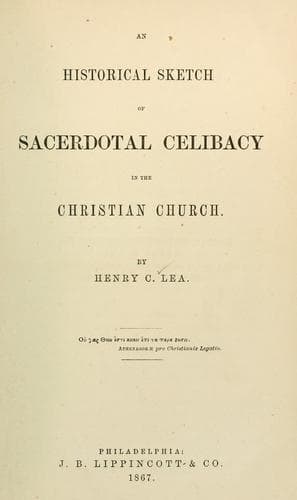
An Historical Sketch of Sacerdotal Celibacy in the Christian ChurchLea, Henry Charles
History
An Historical Sketch of Sacerdotal Celibacy in the Christian Church
Lea, Henry Charles
Catholic Church -- Clergy; Celibacy -- Catholic Church; Church history
Even supposing that this fearful immorality were not attributable to
the immutable laws of nature revenging themselves for their attempted
violation, it could readily be explained by the example set by the
central head. Scarcely had the efforts of Nicholas and Gregory put an
end to sacerdotal marriage in Rome when the morals of the Roman clergy
became a disgrace to Christendom. How little the results of the reform
corresponded with the hopes of the zealous puritans who had brought it
about may be gathered from the martyrdom of a certain Arnolfo, who,
under the pontificate of Honorius II., preached vehemently against the
scandals and immorality of the ecclesiastics of the apostolic city.
They succeeded in making away with him, notwithstanding the protection
of Honorius, and the veneration of the nobles and people who regarded
him as a prophet.[856] When such was the condition of clerical virtue,
we can scarcely wonder that sufficient suffrages were given in 1130 by
the sacred college to Cardinal Pier-Leone to afford him a plausible
claim to the papacy, although he was notoriously stained with the
foulest crimes. Apparently his children by his sister Tropea, and his
carrying about with him a concubine when travelling in the capacity of
papal legate, had not proved a bar to his elevation in the church, nor
to his employment in the most conspicuous and important affairs.[857]
A severer satire on the standard of ecclesiastical morality could
scarcely be imagined than the inculcation by such a man, in his
capacity as pope, of the canons requiring the separation of priests
from their wives, on the plea of the spotless purity required for the
service of the altar.[858]
What were the influences of the papal court in the next century may be
gathered from the speech which Cardinal Hugo made to the Lyonese, on
the occasion of the departure of Innocent IV. in 1251 from their city,
after a residence of eight years—“Friends, since our arrival here,
we have done much for your city. When we came, we found here three
or four brothels. We leave behind us but one. We must own, however,
that it extends without interruption from the eastern to the western
gate”—the crude cynicism of which greatly disconcerted the Lyonese
ladies present.[859] Robert Grosseteste, Bishop of Lincoln, therefore
only reflected the popular conviction when, on his deathbed in 1253,
inveighing against the corruption of the papal court, he applied to it
the lines—
Ejus avaritiæ totus non sufficit orbis,
Ejus luxuriæ meretrix non sufficit omnis.[860]
Public-domain text, read in full here on John Shaqi.
Reviews
Reviews
No reviews yet
Be the first to share your thoughts on this work.
Elsewhere in the archive
Join the Discussion
Join the discussion
Sign in to leave a comment or review.
Sign InorCreate an account