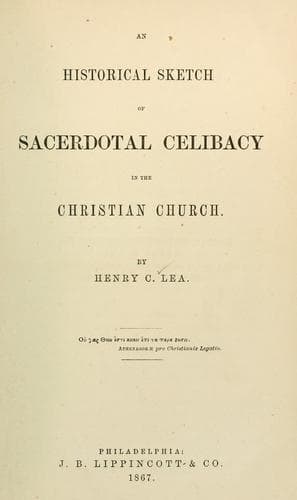
An Historical Sketch of Sacerdotal Celibacy in the Christian ChurchLea, Henry Charles
History
An Historical Sketch of Sacerdotal Celibacy in the Christian Church
Lea, Henry Charles
Catholic Church -- Clergy; Celibacy -- Catholic Church; Church history
A hundred years later saw the popes again in France. For forty years
they had bestowed on Avignon all the benefits, moral and spiritual,
arising from the presence of the Vicegerent of Christ, when Petrarch
recorded, for the benefit of friends whom he feared to compromise by
naming, the impressions produced by his long residence there in the
household of a leading dignitary of the church. Language seems too weak
to express his abhorrence of that third Babylon, that Hell upon Earth,
which could furnish no Noah, no Deucalion to survive the deluge that
alone could cleanse its filth—and yet he intimates that fear compels
him to restrain the full expression of his feelings. Chastity was a
reproach and licentiousness a virtue. The aged prelates surpassed their
younger brethren in wickedness as in years, apparently considering
that age conferred upon them the license to do that from which even
youthful libertines shrank; while the vilest crimes were the pastimes
of pontifical ease.[861] Juvenal and Brantôme can suggest nothing
more shameless or more foul. Nor was the tone of morality heightened
when, fifty years later, Nicholas de Clemanges takes up the tale.
His brief reference to the adulteries and vileness with which the
cardinals befouled the papal court, and the obscenities in which their
families imitated their example, shows that the matter was so generally
understood that it needed no details.[862]
The Great Schism perhaps could scarcely be expected to improve the
morals of the papal court. Yet when the church universal, to close
that weary quarrel, agreed to receive one of the competitors as its
head, surely it might have selected, as the visible representative of
God upon earth, some more worthy embodiment of humanity than Balthazar
Cossa, who, as John XXIII., is alone, of the three competitors,
recognized in the list of popes. When the great council of Constance in
1415 adopted the awful expedient of trying, condemning, and deposing a
pope, the catalogue of crimes—notorious incest, adultery, defilement,
homicide, and atheism—of which the fathers formally accused him, and
which he confessed without defending himself,[863] is fearfully
suggestive of the corruption which could not only spawn such a monster,
but could elevate him to the highest place in the hierarchy, and
present him for the veneration of Christendom. It affords a curious
insight into the notions of morality prevalent in the Papal court to
observe that when he had as chamberlain of Boniface IX., scandalized
Rome by openly keeping his brother’s wife as a concubine, the remedy
adopted for the disorder was to create him Cardinal and send him as
legate to Bologna, while the lady was conveyed to her husband in
Naples. The result of this course of procedure was that during his sway
at Bologna two hundred maids, matrons, and widows, including a few
nuns, fell victims to his brutal lust.[864] So obtuse, in fact, were
Public-domain text, read in full here on John Shaqi.
Reviews
Reviews
No reviews yet
Be the first to share your thoughts on this work.
Elsewhere in the archive
Join the Discussion
Join the discussion
Sign in to leave a comment or review.
Sign InorCreate an account