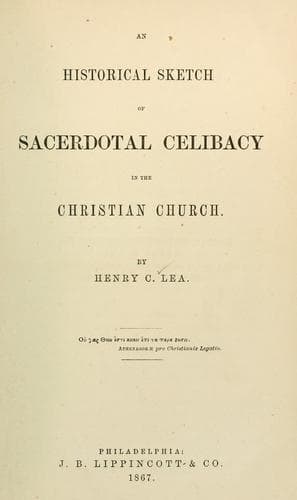
An Historical Sketch of Sacerdotal Celibacy in the Christian ChurchLea, Henry Charles
History
An Historical Sketch of Sacerdotal Celibacy in the Christian Church
Lea, Henry Charles
Catholic Church -- Clergy; Celibacy -- Catholic Church; Church history
Another precursor of Wickliffe and Huss was John of Pirna, who in 1341
taught the most revolutionary doctrines. According to him, the pope was
Antichrist and Rome was the whore of Babylon and the church of Satan.
The Silesians listened eagerly to his denunciations of the clergy, and
the citizens of Breslau, with their magistrates, openly embraced his
heresy. When the Inquisitor, John of Schweidnitz, was sent thither
by the Holy Office of Cracow, the people rose in defence of their
leader and put the Inquisitor to death. John of Pirna appears to have
maintained his position, but after his death the church enjoyed the
pious satisfaction of exhuming his body, burning it, and scattering the
ashes to the winds.[935] It was easier to do this than to destroy the
leaven which was working everywhere in men’s minds. No sooner were its
manifestations repressed in one quarter than they displayed themselves
in another.
In the ineradicable corruption of the church, indeed, every effort to
purify it could only lead to a heresy. Except on the delicate point of
Transsubstantiation, Wickliffe proposed no doctrinal innovation, but
he keenly felt and energetically sought to repress the disorders which
had brought the church into disrepute. His scheme swept away bishop,
cardinal, and pope, the priesthood being the culminating point in
his system of ecclesiastical polity. The temporalities which weighed
down the spiritual aspirations of the church were to be abandoned,
and with them the train of abuses by which the worldly ambition of
churchmen was sustained—indulgences, simony, image-worship, the
power of excommunication, and the thousand other arts by which the
authority to bind and to loose had been converted into broad acres
or current coin of the realm. In all this he was to a great extent a
disciple of the Fraticelli, but his more practical mind escaped their
leading error, and he denounced as an intolerable abuse the beggary
of the mendicant friars. Indeed, the monastic orders in general were
the objects of his special aversion, as having no justification in
the precepts of Christ, and his repeated attacks upon them have a
bitterness which shows not only his deep-rooted aversion, but his sense
of their importance as a bulwark of the abuses which he assailed.[936]
He reduced holy orders to two—the priesthood and diaconate—but he
maintained the indelible character of ordination as separating the
recipient from his fellows, and he urged that all ministers of Christ
should live in saintly poverty.[937] All this was unreasonable enough
in a perverse and stiff-necked generation, but his unpardonable
error was his revival of the doctrine of Gregory VII. regarding the
ministrations of unfaithful priests, which he carried out resolutely to
its logical consequences.[938] According to him, a wicked priest could
not perform his sacred functions, and forfeited both his spiritualities
and temporalities, of which laymen were justified in depriving him. Nay
Public-domain text, read in full here on John Shaqi.
Reviews
Reviews
No reviews yet
Be the first to share your thoughts on this work.
Elsewhere in the archive
Join the Discussion
Join the discussion
Sign in to leave a comment or review.
Sign InorCreate an account