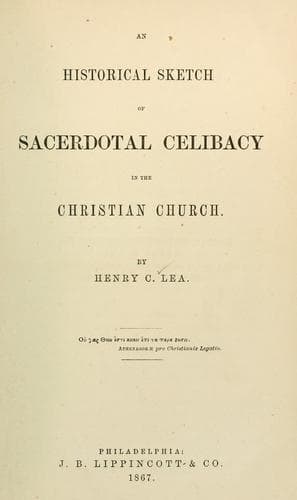
An Historical Sketch of Sacerdotal Celibacy in the Christian ChurchLea, Henry Charles
History
An Historical Sketch of Sacerdotal Celibacy in the Christian Church
Lea, Henry Charles
Catholic Church -- Clergy; Celibacy -- Catholic Church; Church history
more, priest and bishop were no longer priest or bishop if they lived
in mortal sin, and his definition of mortal sin was such as to render
it scarce possible for any one to escape.[939]
What his opinions were on the subject of clerical celibacy was a
mooted point even shortly after his death. Thomas of Walden, the
confessor of Henry V., in his _Doctrinale Fidei_, written to confute
the errors of Lollardry, declares that he could not persuade himself
that the Wickliffites derived from their leader their opposition to
celibacy until he had recently read in Wickliffe’s Sermon on Midsummer
Eve the passage which says that “prestis ben dowid and wyflees agens
Goddis autorite.... And this is the caste of the fend to kyndle fir
in heerdis” &c.,[940] and Mr. Arnold, the latest editor of Wickliffe,
seems to entertain no doubt as to the authenticity of the text, or of
the views of the reformer as expressed there, and in other passages of
tracts attributed to him.[941] Yet had Wickliffe taught this doctrine
it would have been as widely known as his other errors, it would have
been condemned in the repeated proceedings taken against him and his
teachings, and it would not have been left for Thomas of Walden to
discover it in one of the numerous sermons which passed from hand to
hand as the works of the heresiarch. Wickliffe was too earnest and
sincere in his convictions to leave anyone in doubt as to his belief on
any point that he thought worth discussion.
What his views were on this subject can perhaps best be sought in the
most mature of his works, the Trialogus, the authenticity of which I
believe is indisputable. No one can read the chapters on Sensuality and
Chastity without seeing that the whole line of argument is directed
towards proving the superiority of virginity over marriage, even to
the fanciful etymology of “cœlibatus” from the state of the “beati
in cælo;” while in the chapter on the riches of the clergy, they are
regarded as virgins betrothed to Christ, and the vow of chastity which
they take is likened to their similar vow of poverty, and not to be
infringed.[942] Wickliffe’s austerity, in fact, was deeply tinged
with asceticism, and in aiming to restore the primitive simplicity
of the church, he had no thought of relegating its ministers to the
carnalities of family life, which would render impossible the Apostolic
poverty that was his ideal. Even the laity, in his scheme, were to be
so rendered superior to the lusts of the flesh that he pronounced those
who married from any other motive than that of having offspring to be
not truly married.[943] He evidently had no intention to interfere
with clerical celibacy, and the passages which have been cited to the
contrary may safely be regarded as supposititious. Either the writings
in which they occur have been erroneously ascribed to Wickliffe, or the
passages themselves have been interpolated by too zealous disciples,
eager to procure the authority of the master for the later development
Public-domain text, read in full here on John Shaqi.
Reviews
Reviews
No reviews yet
Be the first to share your thoughts on this work.
Elsewhere in the archive
Join the Discussion
Join the discussion
Sign in to leave a comment or review.
Sign InorCreate an account