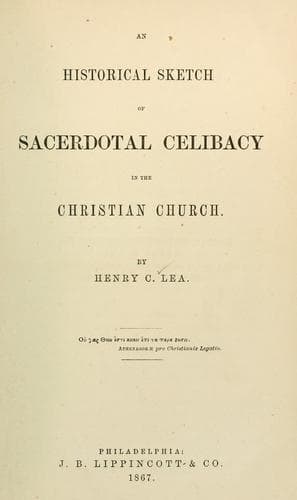
An Historical Sketch of Sacerdotal Celibacy in the Christian ChurchLea, Henry Charles
History
An Historical Sketch of Sacerdotal Celibacy in the Christian Church
Lea, Henry Charles
Catholic Church -- Clergy; Celibacy -- Catholic Church; Church history
of doctrines that were not his—a pious fraud too common in all ages of
the church to excite surprise.
It is easier to start a movement than to restrain it. Wickliffe might
deny the authority of tradition, and yet preserve his respect for
the tradition of celibacy, but his followers could not observe the
distinction. They could see, if he could not, that the structure of
sacerdotalism, to the overthrow of which he devoted himself, could not
be destroyed without abrogating the rule which separated the priest
from his fellow-men, and which severed all other ties in binding him
to the church. In 1394, only ten years after Wickliffe’s death, the
Lollards, by that time a powerful party, with strong revolutionary
tendencies, presented to Parliament a petition for the thorough
reformation of the church, containing twelve conclusions indicating the
points on which they desired change. Of these, the third denounced the
rule of celibacy as the cause of the worst disorders, and argued the
necessity of its abrogation; while the eleventh attacked the vows of
nuns as even more injurious, and demanded permission for their marriage
with but scanty show of respect.[944] This became the received doctrine
of the sect, for in a declaration made in 1400 by Arundel, Archbishop
of Canterbury, concerning the Lollard heresies, we find enumerated
the belief that those in holy orders could take to themselves wives
without sin, and that monks and nuns were at liberty to abandon their
profession, and marry at pleasure.[945]
The fierce persecutions of Henry V., to repress what he rightly
considered as a formidable source of civil rebellion as well as heresy,
succeeded in depriving the sect of political power; yet its religious
doctrines still continued to exist among the people, and even sometimes
obtained public expression.[946] They unquestionably tended strongly to
shake the popular reverence for Rome, and had no little influence in
paving the way for the revolt of the sixteenth century.
* * * * *
Public-domain text, read in full here on John Shaqi.
Reviews
Reviews
No reviews yet
Be the first to share your thoughts on this work.
Elsewhere in the archive
Join the Discussion
Join the discussion
Sign in to leave a comment or review.
Sign InorCreate an account