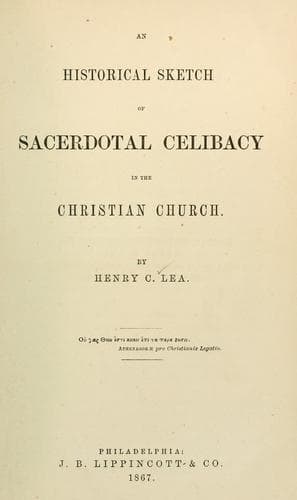
An Historical Sketch of Sacerdotal Celibacy in the Christian ChurchLea, Henry Charles
History
An Historical Sketch of Sacerdotal Celibacy in the Christian Church
Lea, Henry Charles
Catholic Church -- Clergy; Celibacy -- Catholic Church; Church history
John Huss was rather a reformer than a heresiarch. Admirer though
he was of Wickliffe, even to the point of wishing to risk damnation
with him,[947] he avoided the doctrinal errors of the Englishman
on the subject of the Eucharist. Yet his predestinarian views were
unorthodox, and he shared in some degree Wickliffe’s Gregorian ideas
as to the effect of mortal sin in divesting the priesthood of all
claim to sacredness or respect. According to his enemies, he asserted
that no one could be the vicar of Christ or of Peter unless he were an
humble imitator of the virtues of him whom he claimed to represent;
and a pope who was given to avarice was only the representative of
Judas Iscariot.[948] His friend, Jerome of Prague, maintained with
his latest breath that Huss was thoroughly orthodox, and was only
inspired by indignation at seeing the wealth of the church, which was
the patrimony of the poor, lavished on prostitutes, feasting, hunting,
rich apparel, and other unseemly extravagance.[949] In the Bohemian
clergy he had an ample target for his assaults, for they were in no
respect better than their neighbors. During the latter half of the
fourteenth century scarce a synod was held which did not denounce their
vices, gambling, drunkenness, usury, simony, and concubinage; and when
to put an end to the latter irregularity a strict visitation was made
throughout the archiepiscopal diocese of Prague, the cunning rogues
sent away or secreted their partners in guilt, and openly recalled
them as soon as the storm had passed. The following year, Archbishop
Sbinco peremptorily commanded that all concubines should be dismissed
within six days, under pain of perpetual imprisonment, but this was
evidently regarded as a mere _brutum fulmen_, for the next year a new
device was resorted to, by pronouncing all concubinary priests to be
heretics.[950] All this might certainly seem to warrant any effort that
might be made to accomplish what the authorities so signally failed
in doing, but that any individual should assert the right of private
judgment in reforming the church in its head and its members threatened
results too formidable to the whole structure of sacerdotalism, and
the condemnation of Huss was inevitable. Still, like Wickliffe, he was
a devout believer in ascetic purity. His denunciations of the wealth
and disorders of the clergy raised so great an excitement throughout
Bohemia that King Wenceslas was forced to issue a decree depriving
immoral ecclesiastics of their revenues. The partisans of Huss took a
lively interest in the enforcement of this law, and brought the unhappy
ecclesiastics before the tribunals with a pertinacity which amounted to
the persecution of an inquisition.[951]
Public-domain text, read in full here on John Shaqi.
Reviews
Reviews
No reviews yet
Be the first to share your thoughts on this work.
Elsewhere in the archive
Join the Discussion
Join the discussion
Sign in to leave a comment or review.
Sign InorCreate an account