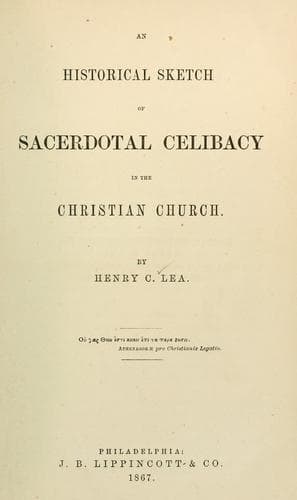
An Historical Sketch of Sacerdotal Celibacy in the Christian ChurchLea, Henry Charles
History
An Historical Sketch of Sacerdotal Celibacy in the Christian Church
Lea, Henry Charles
Catholic Church -- Clergy; Celibacy -- Catholic Church; Church history
Unlike the Lollards, the Hussites maintained the strictness of their
founder’s views on the subject of celibacy. If the fiercer Taborites
cruelly revenged their wrongs upon the religious orders, it was to
punish the minions of Rome, and not to manifest their contempt for
asceticism; and, at the same time, even the milder Calixtins treated
all lapses from clerical virtue among themselves with a severity
which proved their sincerity and earnestness, and which had long
been a stranger to the administration of the church.[952] One of the
complaints against the priesthood formulated in the proclamation of
Procopius and the other chiefs in 1431, at the assembling of the
Council of Bâle, was that the clergy were all fornicators, committing
adultery with men’s wives, or having wives and “presbyterissæ” of
their own;[953] and when, in 1562, the Emperor Ferdinand endeavored to
procure from the Council of Trent the use of the cup for the Utraquists
or Calixtins of Bohemia, he urged in their favor that they would not
admit the ministrations of any priest who did not lead a celibate
life.[954] Traces of the teachings of the Fraticelli, moreover, are
to be found in the doctrines which dissevered temporal from spiritual
power, and denied to the clergy all ownership or dominion over landed
possessions.[955]
The Hussite movement thus was an efficient protest against some of
the forms of sacerdotalism. The nominal reconciliation effected by
the Council of Bâle, against the wishes of the papacy, afforded
considerable scope for religious liberty, which was strengthened by the
alliance between Bohemia and Poland. The reigns of George Podiebrad,
Vlasdislav, and Louis, which extended from 1458 to 1525, favored this
spirit and prepared the soil for the rapid spread of Lutheranism
throughout those regions, which in the sixteenth century narrowly
escaped permanent separation from Catholic unity.
One fragment of the Hussites, however, held wholly aloof from
reconciliation to Rome and professed to uphold in their purity the
doctrines of their founder. These called themselves the Orthodox
Brethren, but were stigmatized by their adversaries with the
opprobrious name of Picardi, in allusion to an obnoxious heresy of the
previous centuries. In process of time they admitted the validity of
priestly marriage, though it was discouraged among them in view of the
dangers to which they were exposed and the constant risk of martyrdom
incurred by all who ventured to be conspicuous among them, for Hussite
and Catholic alike sought their extermination. Yet they bravely
maintained their existence until the Reformation, when they eagerly
fraternized with Luther,[956] such minor differences as existed in the
organization of the respective churches being amicably regulated in
1570 by the agreement of Sendomir.[957]
* * * * *
Public-domain text, read in full here on John Shaqi.
Reviews
Reviews
No reviews yet
Be the first to share your thoughts on this work.
Elsewhere in the archive
Join the Discussion
Join the discussion
Sign in to leave a comment or review.
Sign InorCreate an account