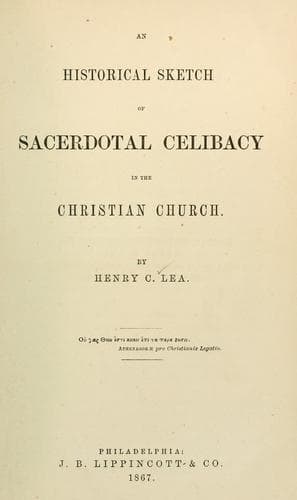
An Historical Sketch of Sacerdotal Celibacy in the Christian ChurchLea, Henry Charles
History
An Historical Sketch of Sacerdotal Celibacy in the Christian Church
Lea, Henry Charles
Catholic Church -- Clergy; Celibacy -- Catholic Church; Church history
condemning him, the good fathers of the Council of Antioch lamented the
general prevalence of the evils thence arising.[56] Cyprian’s prudent
consideration for the weakness of human nature was as yet shared by the
ecclesiastical authorities. In the order of widows professed, which
was recognized by the early church, the Apostolic Constitutions enjoin
that none should be admitted below the age of sixty, in order to avoid
the danger of their infringing their vows by a second marriage, but the
writer is careful to add that such a marriage is not to be condemned
for itself, but only on account of the falsehood which it occasioned.
These widows and virgins were supported out of the tithes of the
church, and were, therefore, necessarily subjected to its control, so
that it is perfectly evident that there was nothing irrevocable in the
vows wherewith they were bound. The change is marked by the end of the
century, when widows who thus forsook their order were unrelentingly
and irrevocably condemned, deprived of communion, and expelled from
social intercourse.[57]
While the Christian world was thus agitated with the speculative
doctrines and practical observances of so many enthusiasts, heretical
and orthodox, who seemed to regard the relations between the sexes as
the crucial test and most trustworthy exponent of religious ardor, a
new dogma arose in the East and advanced with a rapidity which shows
how much progress the ascetic spirit had already made, and how ripe
were the unsettled minds of zealots to welcome whatever system of
belief promised to trample most ruthlessly upon nature, and to render
the path of salvation inaccessible to all save those capable of the
sternest self-mortification. Towards the end of the third century, the
Persian Manes made his advent in the Empire, proclaiming himself as
the Paraclete and as a new and higher Apostle. Though his career as
an envoy of Christ was stoutly resisted by the orthodox, and though,
after a chequered life, he was flayed alive, and his followers in
Persia were slaughtered by Varahran I.,[58] his western disciples were
more fortunate, and the hateful name of Manichæan acquired a sinister
notoriety which maintained its significance for a thousand years.
His system was a compound of several faiths, and though it failed in
its comprehensive design to bring all mankind together in one form
of belief, it yet had features which won for it the enthusiastic
adhesion of men of diverse races. The way was already prepared for its
reception among both Gentiles and Christians by the prevalence on the
one hand of the Mithraic worship, and on the other of Gnosticism. The
Dualistic theory was attractive to those who were disheartened in the
vain attempt to reconcile the existence of evil with an omnipotent
and all-merciful Creator; the Platonic identity of the soul with the
Godhead was a recommendation to the schoolmen; the Brahmanical and
Buddhist views as to abstinence from meat and marriage won adherents
Public-domain text, read in full here on John Shaqi.
Reviews
Reviews
No reviews yet
Be the first to share your thoughts on this work.
Join the Discussion
Join the discussion
Sign in to leave a comment or review.
Sign InorCreate an account