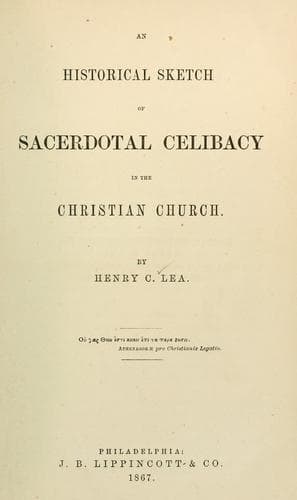
An Historical Sketch of Sacerdotal Celibacy in the Christian ChurchLea, Henry Charles
History
An Historical Sketch of Sacerdotal Celibacy in the Christian Church
Lea, Henry Charles
Catholic Church -- Clergy; Celibacy -- Catholic Church; Church history
the practical application given to the texts commonly cited in defence
of the prohibition of marriage.[52]
Not all, however, who sought the praise or the merits of austerity
were prepared to pay such a price for victory in the struggle with
themselves. Enthusiastic spirits, exalted with the prospect of earthly
peace and heavenly rewards promised to those who should preserve the
purity of virginity and live abstracted from the cares and pleasures
of family life, frequently took the vow of continence which had
already become customary. This vow as yet was purely voluntary. It
bound those who assumed it only during their own pleasure, nor were
they during its continuance, in any way segregated from the world. So
untrammelled, indeed, were their actions that Cyprian is forced to
rebuke the holy virgins for frequenting the public baths in which both
sexes indiscriminately exposed themselves, and he does not hesitate to
attribute to this cause much of the ruin and dishonor of its votaries
which afflicted the church.[53] Yet, this was by no means the severest
trial to which many of them subjected their constancy. Perhaps it was
to court spiritual martyrdom and to show to their admirers a virtue
robust enough to endure the most fiery trials, perhaps it was that they
found too late that they had overestimated their strength, and that
existence was a burden without the society of some beloved object—but,
whatever may have been the motive, it became a frequent custom to
associate themselves with congenial souls of the other sex, and form
Platonic unions in which they aspired to maintain the purity which they
had vowed to God. At the best, the sensible members of the church were
scandalized by these performances, which afforded so much scope for
the mockery of the heathen; but scandal frequently was justified, for
Nature often asserted her outraged rights to the shame and confusion
of the hapless votaries of an artificial and superhuman perfection.
Tertullian does not hesitate to assert that the desire of enjoying the
reputation of virginity led to much secret immorality, the effects of
which were concealed by resort to infanticide.[54] Cyprian chronicles,
not with surprise but sorrow, the numerous instances which he had known
of ruin resulting to those who had so fatally miscalculated their power
of resistance: with honest indignation he denounces the ecclesiastics
who abandoned themselves to practices which, if not absolutely
criminal, were brutally degrading: and with a degree of common-sense
hardly to be looked for in so warm an admirer of the perfection of
virginity, he advises that those whose weakness rendered doubtful the
strict observance of their vows should return to the world and satisfy
their longings in legitimate marriage.[55] The heresiarch Paul of
Samosata affords, perhaps, the most conspicuous example of the extent
to which these and similar practices were sometimes carried, and in
Public-domain text, read in full here on John Shaqi.
Reviews
Reviews
No reviews yet
Be the first to share your thoughts on this work.
Join the Discussion
Join the discussion
Sign in to leave a comment or review.
Sign InorCreate an account