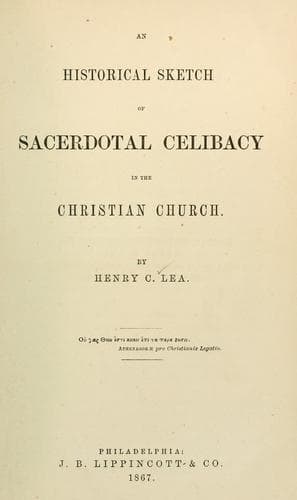
An Historical Sketch of Sacerdotal Celibacy in the Christian ChurchLea, Henry Charles
History
An Historical Sketch of Sacerdotal Celibacy in the Christian Church
Lea, Henry Charles
Catholic Church -- Clergy; Celibacy -- Catholic Church; Church history
that the tenets of the Manichæans have been exaggerated by their
opponents in controversy, and that in process of time, when the church
became avowedly ascetic, there was practically little difference on
this point between Manichæism and Orthodoxy. St. Augustin, indeed,
represents the Manichæan Faustus as arguing that both in doctrine and
practice his sect only followed the example of the church. He ridicules
the idea that it could prohibit marriage, and asserts positively that
it only encouraged those who manifested a desire to persevere in
continence. If this is to be received as an authentic exposition of
Manichæan principles, it will be seen that the church was not long in
outstripping the heretics.[64]
In fact, even as early as the time of Cyprian, that saint, in allusion
to the parable of the sower, had rated the comparative merits of
martyrdom to virginity as one hundred to sixty; while, after martyrdom
had gone out of fashion, St. Patrick, in the fifth century, undertook
a more elaborate classification in which bishops and doctors of the
church, monks and virgins, were rated at one hundred, ecclesiastics in
general and widows professed at sixty, while the faithful laity stand
only at thirty.[65] It was therefore a heresy for Jovinian to claim
equal merit for maidens, wives, and widows; and though St. Jerome, in
controverting this, commenced by carefully denying any intentional
disrespect towards marriage, still his controversial ardor carried
him so far in that direction, that he aroused considerable feeling
among reasonable men and was obliged formally and repeatedly to excuse
himself. His contempt for marriage, indeed, was so extreme that in
spite of the recognized primacy of St. Peter, he considered that
apostle as decidedly inferior to St. John, because the one had a wife
and the other was a virgin—apparently not observing that, as he denied
the marriage of all the apostles save Peter, he was thus relegating the
head of the church to the last place among the holy twelve.[66] St.
Augustin recognized the difficulty of reconciling the current views of
his time with the necessities of humanity when he wrote a treatise for
the purpose of proving the difference between the good of marriage and
the evil of carnal desire, which, while it perpetuated the species,
likewise perpetuated original sin; and he gave a signal example of the
manner in which enthusiastic asceticism sought to improve upon the work
of the Creator when he uttered the pious wish that all mankind should
abstain from marriage, so that the human race might the sooner come to
an end.[67] St. Martin of Tours was somewhat less extravagant when he
was willing to admit that marriage was pardonable, while licentiousness
was punishable and virginity glorious; and he was far behind the
enthusiasts of his time, for, while he deplores the miserable folly of
those who consider marriage to be equal to virginity, he is likewise
Public-domain text, read in full here on John Shaqi.
Reviews
Reviews
No reviews yet
Be the first to share your thoughts on this work.
Join the Discussion
Join the discussion
Sign in to leave a comment or review.
Sign InorCreate an account