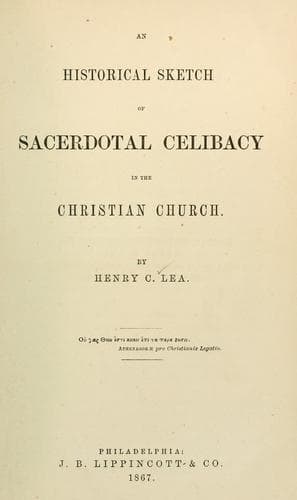
An Historical Sketch of Sacerdotal Celibacy in the Christian Church — John Shaqi
An Historical Sketch of Sacerdotal Celibacy in the Christian ChurchLea, Henry Charles
History
An Historical Sketch of Sacerdotal Celibacy in the Christian Church
Lea, Henry Charles
Catholic Church -- Clergy; Celibacy -- Catholic Church; Church history
obliged to reprove the error of those who were willing only to compare
it to lechery—the former belief being evidently much more erroneous
than the latter in the Saint’s estimation.[68] So a treatise on
chastity, which passes under the name of Sixtus III., barely admits
that married people can earn eternal life; and it apparently is only
the dread of being classed with Manichæans that leads the author to
shrink from the conclusions of his own reasoning, and to state that
he does not absolutely condemn wedlock or prohibit it to those who
cannot restrain their passions.[69] Not a little Manichæan in its
tendency is a declaration of Gregory the Great to Augustin the Apostle
of England that connubial pleasures cannot possibly be free from sin;
and quite as decided is another assertion of the same Pope that the
strictness of monastic life is the only possible mode of salvation
for the greater portion of mankind.[70] It was the natural practical
deduction from this which is drawn by the Penitential of Theodore,
when it commands those who contract a first marriage to abstain from
entering a church for thirty days, after which they are to perform
penance for forty more; while a digamus is subjected to penance for a
year, and a trigamus, or one oftener married, for seven years.[71] When
marriage was thus regarded as a sin, we can scarcely be surprised at
the practical Manichæism of Epiphanius who declares that the church is
based upon virginity as on its corner-stone.[72]
This ascetic development, however, was not destined to triumph
without occasional efforts at repression. At the close of the third
century, the highest authorities of the church still condemned the
ruthless asceticism, which was subsequently glorified as the loftiest
achievement of Christian virtue. Thus in the Apostolic Constitutions,
the influence of Manichæism and its kindred sects is as yet only
manifested by the opposition aroused to their doctrines; and the
necessity of that opposition is indicated by the careful and repeated
declaration of the purity and sanctity of the marriage-tie, both as
regards the priesthood and the laity. Not less instructive is the bare
toleration almost grudgingly extended to vows of celibacy, and the
cautious restriction which declares that such vows are not to be held
as justifying a disparagement of matrimony.[73] No stronger contrast
can be looked for than that produced by little more than a century
between the rational piety of these provisions and the extravagant
rhapsodies of Jerome, Augustin, and Martin. The calm good sense of
Lactantius also takes occasion to reprove the extravagance which
regarded all indulgence of the natural affections as a sin requiring
repentance and pardon. He assumes indeed that perpetual continence,
as being opposed to the law of nature, is not recommended, but only
permitted by the Creator, thus reversing the maxims of the zealots.[74]
Equally suggestive are the Apostolic Canons. The sixth of these
Public-domain text, read in full here on John Shaqi.
Reviews
Reviews
No reviews yet
Be the first to share your thoughts on this work.
Join the Discussion
Join the discussion
Sign in to leave a comment or review.
Sign InorCreate an account