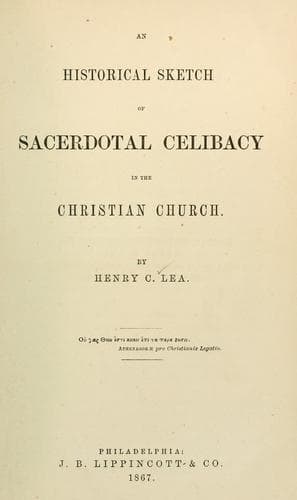
An Historical Sketch of Sacerdotal Celibacy in the Christian ChurchLea, Henry Charles
History
An Historical Sketch of Sacerdotal Celibacy in the Christian Church
Lea, Henry Charles
Catholic Church -- Clergy; Celibacy -- Catholic Church; Church history
The term “subintroducta mulier”—γυνη συνεισακτος—is almost invariably
used in an unfavorable sense, and is equivalent to the “fœmina
extranea,” and nearly to the “focaria” and “concubina” of later times,
as well as to the “agapeta” and “dilecta” of earlier date. We have
already seen how Cyprian, seventy-five years before, denounced the
agapetæ who even then were so common, and whose companionship proved
so disastrous to all parties, but the custom continued, and its evil
consequences became more and more openly and shamelessly displayed. In
314 the council of Ancyra denounced it in terms implying its public
recognition.[84] At the close of the same century, Jerome still finds
in it ample material for his fiery indignation; and his denunciations
manifest that it was still a corroding cancer in the purity of the
church, prevailing to an extent that rendered its suppression a matter
of the utmost importance.[85] The testimony of Epiphanius is almost
equally strong, and shows that it was a source of general popular
reproach.[86] Such a reform was therefore well worthy the attention of
the Nicene fathers, and that this was the special object of the canon
is indicated by Jerome himself, who appeals to it as the authority
under which an ecclesiastic refusing to separate himself from his
agapeta could be punished; it was to be read to the offender, and if he
neglected obedience to its commands, he was to be anathematized.[87]
That it had no bearing upon the wives of priests can moreover be proved
by several reasons. The restriction on matrimony has never at any time
extended below the subdiaconate, the inferior grades of the secular
clergy having always been free to live with their wives, even in the
periods of the most rigid asceticism. The canon, however, makes no
distinction. Its commands are applicable “alicui omnino qui in clero
est.” To suppose, therefore, that it was intended to include wives
in its restriction is to prove too much—the _reductio ad absurdum_
is complete.[88] Equally convincing is the fact that when, towards
the close of the century, the rule of celibacy and separation was
introduced, and Siricius and Innocent I. ransacked the Gospels for
texts of more than doubtful application with which to support the
innovation, they made no reference whatever to the Nicene canon.[89]
Had it been understood at that period as bearing on the subject, it
would have been all-sufficient in itself. The reverence felt for the
Council of Nicæa was too great, and the absolute obedience claimed
for its commands was too willingly rendered, for such an omission to
be possible. That Siricius and Innocent should not have adduced it
is therefore proof incontrovertible that it was as yet construed as
directed solely against the improper companions of the clergy. If
further evidence to the same effect be required, it may be found in
a law of Honorius, promulgated in 420, in which, while forbidding
Public-domain text, read in full here on John Shaqi.
Reviews
Reviews
No reviews yet
Be the first to share your thoughts on this work.
Join the Discussion
Join the discussion
Sign in to leave a comment or review.
Sign InorCreate an account