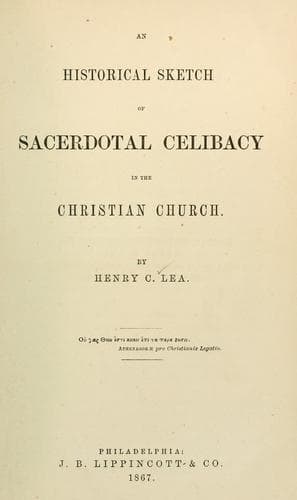
An Historical Sketch of Sacerdotal Celibacy in the Christian ChurchLea, Henry Charles
History
An Historical Sketch of Sacerdotal Celibacy in the Christian Church
Lea, Henry Charles
Catholic Church -- Clergy; Celibacy -- Catholic Church; Church history
With the fruitlessness of its endeavors to
extinguish the Arian controversy we have nothing to do, but in its
legislative capacity its labors had an influence upon our subject
which merits a closer examination than would appear necessary from the
seemingly unimportant nature of the proceedings themselves.
With the full belief that the canons of a general council were the
direct operation of the Holy Ghost, they were of course entitled to
unquestioning reverence, and those of Nicæa have always been regarded
as of special and peculiar authority, cutting off all debate on any
question to which they might be applicable. The third of the series has
been the main reliance of sacerdotal controversialists, and has been
constantly appealed to as the unanswerable justification for enforcing
the rule of discipline which enjoined celibacy on all admitted to
holy orders. Its simple phraseology would hardly seem to warrant such
conclusion. “The Great Synod has strictly forbidden to bishop, priest,
and deacon, and to every ecclesiastic, to have a ‘subintroductam
mulierem,’ unless perhaps a mother, a sister, an aunt, or such person
only as may be above suspicion.”[83]
This is the only allusion to the subject in the Nicene canons. As it
does not include wives among those exempted from the prohibition of
residence, we can hardly be surprised that those who believe celibacy
to be of apostolic origin should assume that it was intended to
pronounce an absolute separation between husband and wife. As the
Council of Elvira, however, contains the only enunciation of such a
rule previous to that of Nicæa, and as those of Ancyra and Neocæsarea
and the Apostolic Constitutions and Canons, directly or indirectly,
allow the conjugal relations of ecclesiastics to remain undisturbed,
we are certainly justified in assuming the impossibility that an
innovation of so much importance would be introduced in the discipline
of the universal church without being specifically designated and
commanded in terms which would admit of no misunderstanding. That the
meaning of the canon is really and simply that alone which appears on
the surface—to put an end to the disorders and scandals arising from
the improper female companions of unmarried priests—is, moreover, I
think, susceptible of easy demonstration.
Public-domain text, read in full here on John Shaqi.
Reviews
Reviews
No reviews yet
Be the first to share your thoughts on this work.
Join the Discussion
Join the discussion
Sign in to leave a comment or review.
Sign InorCreate an account