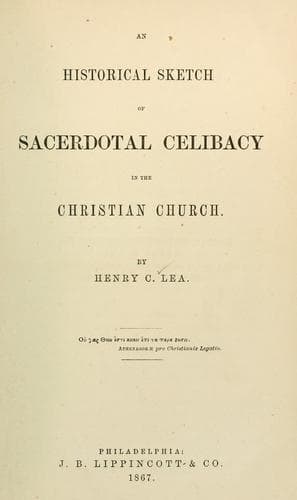
An Historical Sketch of Sacerdotal Celibacy in the Christian ChurchLea, Henry Charles
History
An Historical Sketch of Sacerdotal Celibacy in the Christian Church
Lea, Henry Charles
Catholic Church -- Clergy; Celibacy -- Catholic Church; Church history
Perhaps this may not move our surprise when we glance at the condition
of morality existing throughout the Empire in the second quarter of
the fifth century, as sketched by a zealous churchman of the period.
Salvianus, Bishop of Marseilles, was a native of Trèves. Three times he
witnessed the sack of that unfortunate city by the successive barbarian
hordes which swept over Western Europe, and he lifts up his voice,
like Jeremiah, to bewail the sins of his people, and the unutterable
misfortunes which were the punishment but not the cure of those
sins. Nothing can be conceived more utterly licentious and depraved
than the whole framework of society as described by him, with such
details as preclude us from believing that holy indignation or pious
sensibility led him to exaggerate the outlines or to darken the shades
of the picture. The criminal and frivolous pleasures of a decrepit
civilization left no thought for the absorbing duties of the day or the
fearful trials of the morrow. Unbridled lust and unblushing indecency
admitted no sanctity in the marriage-tie. The rich and powerful
established harems, in the recesses of which their wives lingered,
forgotten, neglected, and despised. The banquet, the theatre, and the
circus exhausted what little strength and energy were left by domestic
excesses. The poor aped the vices of the rich, and hideous depravity
reigned supreme and invited the vengeance of Heaven. Such rare souls
as could remain pure amid the prevailing contamination would naturally
take refuge in the contrast of severe asceticism, and resolutely seek
absolute seclusion from a world whose every touch was pollution. The
secular clergy, however, drawn from the ranks of a society so utterly
corrupt, and enjoying the wealth and station which rendered their
position an object for the ambition of the worldly, could not avoid
sharing to a great extent the guilt of their flocks, whose sins were
more easily imitated than eradicated. Nor does Salvianus confine his
denunciations to Gaul and Spain. Africa and Italy are represented as
even worse, the prevalence of unnatural crimes lending a deeper disgust
to the rivalry in iniquity. Rome was the sewer of the nations, the
centre of abomination of the world, where vice openly assumed its most
repulsive form, and wickedness reigned unchecked and supreme.
Public-domain text, read in full here on John Shaqi.
Reviews
Reviews
No reviews yet
Be the first to share your thoughts on this work.
Elsewhere in the archive
Join the Discussion
Join the discussion
Sign in to leave a comment or review.
Sign InorCreate an account