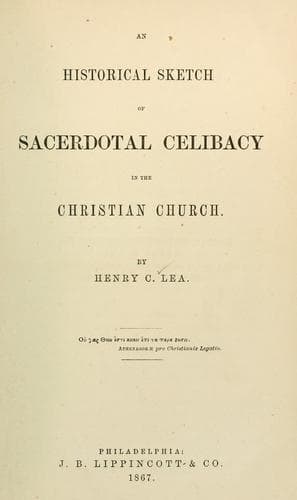
An Historical Sketch of Sacerdotal Celibacy in the Christian ChurchLea, Henry Charles
History
An Historical Sketch of Sacerdotal Celibacy in the Christian Church
Lea, Henry Charles
Catholic Church -- Clergy; Celibacy -- Catholic Church; Church history
It is true that the descriptions of Salvianus are intended to include
the whole body of the people, and that his special references to the
church are but few. Those occasional references, however, are not of a
nature to exempt it from sharing in the full force of his indignation.
When he pronounces the Africans to be utterly licentious, he excepts
those who have been regenerated in religion—but these he declares to
be so few in number that it is difficult to believe them Africans.
What hope, he asks, can there be for the people when even in the church
itself the most diligent search can scarce discover one chaste amid so
many thousands: and when imperial Carthage was tottering to its fall
under the assaults of the besieging Vandals, he describes its clergy
as wantoning in the circus and the theatre—those without falling under
the sword of the barbarian, those within abandoning themselves to
sensuality.[150] This, be it remembered, is that African church which
had just been so carefully nurtured in the purest asceticism for thirty
years, under the unremitting care of Augustin, who died while his
episcopal city of Hippo was encircled with the leaguer of the Vandals.
Nor were these disorders attributable to the irruption of the
Barbarians, for Salvianus sorrowfully contrasts their purity of morals
with the reckless dissoluteness of the Romans. The respect for female
virtue, inherent in the Teutonic tribes, has no warmer admirer than he,
and he recounts with wonder how the temptations of luxury and vice,
spread before them in the wealthy cities which they sacked, excited
only their disgust, and how, so far from yielding to the allurements
that surrounded them, they sternly set to work to reform the depravity
of their new subjects, and enacted laws to repress at least the open
manifestations which shocked their untutored virtue.
When corruption so ineradicable pervaded every class, we can scarce
wonder that in the story of the trial of Sixtus III., in 440, for the
seduction of a nun, when his accusers were unable to substantiate the
charge, he is said to have addressed the synod assembled in judgment
by repeating to them the story of the woman taken in adultery, and
the decision of Christ. Whether it were intended to be regarded as a
confession, or as a sarcasm on the prelates around him, whom he thus
challenged to cast the first stone, the tale whether true or false is
symptomatic of the time.[151]
As regards the East, if the accusations brought against Ibas,
Metropolitan of Edessa, at the Synod of Berytus in 448,[152] are
worthy of credit, the Oriental church was not behind the West in the
effrontery of sin.
VI.
THE EASTERN CHURCH.
Public-domain text, read in full here on John Shaqi.
Reviews
Reviews
No reviews yet
Be the first to share your thoughts on this work.
Elsewhere in the archive
Join the Discussion
Join the discussion
Sign in to leave a comment or review.
Sign InorCreate an account