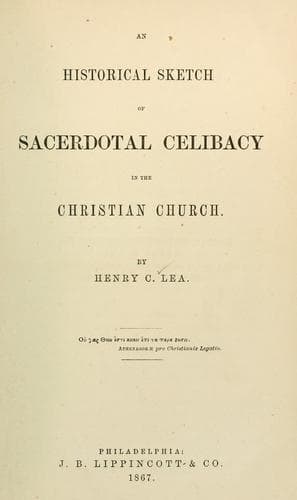
An Historical Sketch of Sacerdotal Celibacy in the Christian ChurchLea, Henry Charles
History
An Historical Sketch of Sacerdotal Celibacy in the Christian Church
Lea, Henry Charles
Catholic Church -- Clergy; Celibacy -- Catholic Church; Church history
During the period which we have been considering, there had gradually
arisen a divergence between the Christians of the East and of the
West. The Arianism of Constantius opposed to the orthodoxy of Constans
lent increased development to the separation which the division of the
Empire had commenced. The rapid growth of the New Rome founded on the
shores of the Bosporus gave to the East a political metropolis which
rendered it independent of the power of Rome, and the patriarchate
there erected absorbed to itself the supremacy of the old Apostolic
Sees, which had previously divided the ecclesiastical strength of the
East. In the West, the Bishop of Rome was unquestionably the highest
dignitary, and when the separation relieved him of the rivalry of
prelates equal in rank, he was enabled to acquire an authority over
the churches of the Occident undreamed of in previous ages. As yet,
however, there was little pretension of extending that power over
the East, and though the ceaseless quarrels which raged in Antioch,
Constantinople, and Alexandria enabled him frequently to intervene
as arbiter, still he had not yet assumed the tone of a judge without
appeal or of an autocratic lawgiver.
Though five hundred years were still to pass before the Greek schism
formally separated Constantinople from the communion of Rome, yet
already, by the close of the fourth century, the characteristics which
ultimately led to that schism were beginning to develop themselves with
some distinctness. The sacerdotal spirit of the West showed itself
in the formalism which loaded religion with rules of observance and
discipline enforced with Roman severity. The inquiring and metaphysical
tendencies of the East discovered unnumbered doubtful points of
belief, which were argued with exhaustive subtlety and supported by
relentless persecution. However important it might be for any polemic
to obtain for his favorite dogma the assent of the Roman bishop,
whose decisions on such points thus constantly acquired increased
authority, yet when the Pope undertook to issue laws and promulgate
rules of discipline, whatever force they had was restricted to the
limits of the Latin tongue. Accordingly, we find that the decretals
of Siricius and Innocent I. produced no effect throughout the East.
Asceticism continued to flourish there as in its birthplace, but it was
voluntary, and there is no trace of any official attempt to render it
universally imperative. The canon of Nicæa of course was law, and the
purity of the church required its strict observance, to avoid scandals
and immorality;[153] but beyond this and the ancient rules excluding
digami and prohibiting marriage in orders no general laws were insisted
on, and each province or patriarchate was allowed to govern itself in
this respect. How little the Eastern prelates thought of introducing
compulsory celibacy is shown by the fact that at the second general
council, held at Constantinople in 381, only four or five years before
Public-domain text, read in full here on John Shaqi.
Reviews
Reviews
No reviews yet
Be the first to share your thoughts on this work.
Elsewhere in the archive
Join the Discussion
Join the discussion
Sign in to leave a comment or review.
Sign InorCreate an account