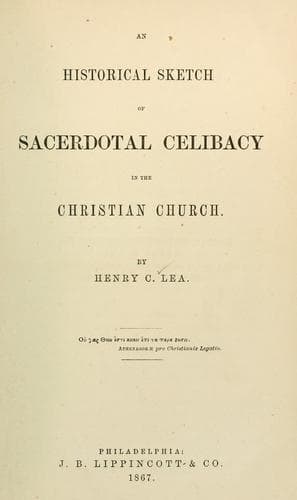
An Historical Sketch of Sacerdotal Celibacy in the Christian ChurchLea, Henry Charles
History
An Historical Sketch of Sacerdotal Celibacy in the Christian Church
Lea, Henry Charles
Catholic Church -- Clergy; Celibacy -- Catholic Church; Church history
the decretals of Siricius, there is no trace of any legislation on
the subject; and this acquires increased significance when we observe
that although this council has always been reckoned Œcumenic, and has
enjoyed full authority throughout the church universal, yet out of
one hundred and fifty bishops who signed the acts, but one—a Spanish
prelate—was from the West.
This avoidance of action was not merely an omission of surplusage.
Had the disposition existed to erect the custom of celibacy into a
law, there was ample cause for legislation on the subject. Epiphanius,
who died in the year 403 at a very advanced age, probably compiled
his “Panarium” not long after this period; he belonged to the extreme
school of ascetics, and lost no opportunity of asserting the most rigid
rule with regard to virginity and continence, which he considered to
be the base and corner-stone of the church. While assuming celibacy
to be the rule for all concerned in the functions of the priesthood,
he admits that in many places it was not observed, on account of the
degradation of morals or of the impossibility of obtaining enough
ministers irreprehensible in character to satisfy the needs of the
faithful.[154]
That Epiphanius endeavored to erect into a universal canon rules only
adopted in certain churches is rendered probable by an allusion of St.
Jerome, who, in his controversy with Vigilantius, urged in support
of celibacy the custom of the churches of the East (or Antioch), of
Alexandria, and of Rome.[155] He thus omits the great exarchates of
Ephesus, Pontus, and Thrace, as not lending strength to his argument.
Of these the first is perhaps explicable by the latitudinarianism
of its metropolitan, Anthony, Bishop of Ephesus. At the council of
Constantinople, held in 400, this prelate was accused of many crimes,
among which were simony, the conversion to the use of his family of
ecclesiastical property and even of the sacred vessels, and further,
that after having vowed separation from his wife, he had had children
by her.[156] Even Egypt, the nursery of monachism, affords a somewhat
suspicious example in the person of Synesius, Bishop of Ptolemais. This
philosophic disciple of Hypatia, when pressed to accept the bishopric,
declined it on various grounds, among which was his unwillingness
to be separated from his wife, or to live with her secretly like an
adulterer, the separation being particularly objectionable to him, as
interfering with his desire for numerous offspring.[157] Synesius,
however, was apparently able to reconcile the incompatibilities, for
after accepting the episcopal office, we find, when the Libyans invaded
the Pentapolis and he stood boldly forth to protect his flock, that two
days before an expected encounter, he confided to his brother’s care
his children, to whom he asked the transfer of that tender fraternal
affection which he himself had always enjoyed.[158]
Public-domain text, read in full here on John Shaqi.
Reviews
Reviews
No reviews yet
Be the first to share your thoughts on this work.
Elsewhere in the archive
Join the Discussion
Join the discussion
Sign in to leave a comment or review.
Sign InorCreate an account