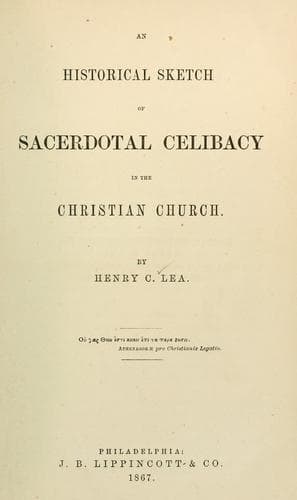
An Historical Sketch of Sacerdotal Celibacy in the Christian ChurchLea, Henry Charles
History
An Historical Sketch of Sacerdotal Celibacy in the Christian Church
Lea, Henry Charles
Catholic Church -- Clergy; Celibacy -- Catholic Church; Church history
It is easy to imagine what efforts were doubtless made to extend the
rule and to render it as imperative throughout the East as it was
becoming in the West, when we read the extravagant laudations of
virginity uttered about this time by St. John Chrysostom, who lent
the sanction of his great name and authority to the assertion that
it is as superior to marriage as heaven is to earth, or as angels
are to men.[159] Strenuous as these efforts may have been, however,
they have left no permanent record, and their effect was short-lived.
Within thirty years of the time when Jerome quoted the example of
the eastern churches as an argument against Vigilantius, Socrates
chronicles as a novelty the introduction into Thessalia of compulsory
separation between married priests and their wives, which he says was
commanded by Heliodorus, Bishop of Trica, apparently to compensate for
the amatory character of the “Æthiopica,” written in his youth. The
same rule, Socrates informs us, was observed in Greece, Macedonia,
and Thessalonica, but throughout the rest of the East he asserts that
such separation was purely voluntary, and even that many bishops had
no scruple in maintaining ordinary intercourse with their wives[160]—a
statement easy to be believed in view of the complaints of St. Isidor
of Pelusium, about the same time, that the rules of the church
enjoining chastity received little respect among the priesthood.[161]
The influence of Jerome, Chrysostom, and other eminent churchmen, the
example of the West, and the efforts of the Origenians in favor of
philosophic asceticism, doubtless had a powerful effect during the
first years of the fifth century in extending the custom, but they
failed in the endeavor to render it universal and obligatory, and the
testimony of Socrates shows how soon even those provinces which adopted
it in Jerome’s time returned to the previous practice of leaving the
matter to the election of the individual. The East thus preserved the
traditions of earlier times, as recorded in the Apostolic Constitutions
and Canons, prohibiting marriage in orders and the ordination of
digami, but imposing no compulsory separation on those who had been
married previous to ordination.
Public-domain text, read in full here on John Shaqi.
Reviews
Reviews
No reviews yet
Be the first to share your thoughts on this work.
Elsewhere in the archive
Join the Discussion
Join the discussion
Sign in to leave a comment or review.
Sign InorCreate an account