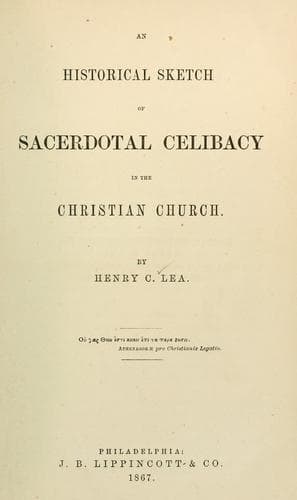
An Historical Sketch of Sacerdotal Celibacy in the Christian ChurchLea, Henry Charles
History
An Historical Sketch of Sacerdotal Celibacy in the Christian Church
Lea, Henry Charles
Catholic Church -- Clergy; Celibacy -- Catholic Church; Church history
Even these rules required to be occasionally enunciated in order to
maintain their observance. In 530 a constitution of Justinian calls
attention to the regulation prohibiting the marriage of deacons and
subdeacons, and in view of the little respect paid to it, the Emperor
proceeds to declare the children of such unions spurious (not even
nothi or naturales) and incompetent to inherit anything; the wife is
likewise incapacitated from inheritance, and the whole estate of the
father is escheated to the church—the severity of which may perhaps
be a fair measure of the extent of the evil which it was intended
to repress.[162] Five years later Justinian recurs to the subject,
and lays down the received regulations in all their details. Any
one who keeps a concubine, or who has married a divorced woman or a
second wife, is to be held ineligible to the diaconate or priesthood.
Any member of those orders or of the subdiaconate who takes a wife
or a concubine, whether publicly or secretly, is thereupon to be
degraded and to lose all clerical privileges; and though the strongest
preference is expressed for those who though married preserve
strict continence, the very phrase employed indicates that this was
altogether a matter of choice, and that previous conjugal relations
were not subject to any legislative interference.[163] These same
regulations were repeated some ten years later in a law, promulgated
about 545,[164] which was preserved throughout the whole period of
Greek jurisprudence, being inserted by Leo the Philosopher in his
Basilica,[165] quoted by Photius in the Nomocanon, and referred to as
still in force by Balsamon in the thirteenth century.[166] At the same
time Justinian tacitly admits the failure of previous efforts when he
adds a provision by which an unmarried postulant for the diaconate is
obliged to pledge himself not to marry, and any bishop permitting such
marriage is threatened with degradation.[167]
Public-domain text, read in full here on John Shaqi.
Reviews
Reviews
No reviews yet
Be the first to share your thoughts on this work.
Elsewhere in the archive
Join the Discussion
Join the discussion
Sign in to leave a comment or review.
Sign InorCreate an account