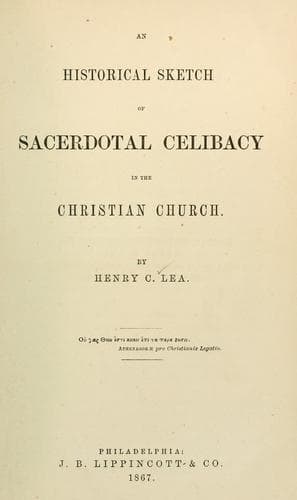
An Historical Sketch of Sacerdotal Celibacy in the Christian ChurchLea, Henry Charles
History
An Historical Sketch of Sacerdotal Celibacy in the Christian Church
Lea, Henry Charles
Catholic Church -- Clergy; Celibacy -- Catholic Church; Church history
Bishops, however, were subjected to the full severity of the Latin
discipline. As early as 528, Justinian ordered that no one should be
eligible to the episcopate who was burdened with either children or
grandchildren, giving as a reason the engrossing duties of the office,
which required that the whole mind and soul should be devoted to them,
and still more significantly hinting the indecency of converting to the
use of the prelate’s family the wealth bestowed by the faithful on the
church for pious uses and for charity.[168] It is probable that this
was not strictly observed, for in 535, when repeating the injunction,
and adding a restriction on conjugal intercourse, he intimates that no
inquiry shall be made into infractions previously occurring, but that
it shall be rigidly enforced for the future.[169] The decision was
final as regards the absence of a wife, for it was again alluded to in
548, and that law is carried through the Nomocanon and Basilica.[170]
The absence of children as a prerequisite to the episcopate, however,
was not insisted upon so pertinaciously, for Leo the Philosopher,
after the compilation of the Basilica, issued a constitution allowing
the ordination of bishops who had legitimate offspring, arguing that
brothers and other relatives were equally prone to withdraw them from
the duties of their position.[171]
* * * * *
It is not worth while to enter into the interminable controversy
respecting the council held at Constantinople in 680, the canons of
which were promulgated in 692, and which is known to polemics as the
_Quinisext in Trullo_. The Greeks maintain that it was Œcumenic,
and its legislation binding upon Christendom; the Latins, that it
was provincial and schismatic; but whether Pope Agatho acceded to
its canons or not; whether a century later Adrian I. admitted them,
or whether their authentication by the second council of Nicæa gave
them authority over the whole church or not, are questions of little
practical importance for our purpose, for they never were really
incorporated into the law of the West, and they are only to be regarded
as forming a portion of the received ecclesiastical jurisprudence of
the East. In one sense, however, their bearing upon the Latin church
is interesting, for, in spite of them, Rome maintained communion with
Constantinople for more than a century and a half, and the schism which
then took place arose from altogether different causes. In the West,
therefore, celibacy was only a point of discipline, of no doctrinal
importance, and not a matter of heresy, as we shall see it afterwards
become under the stimulus afforded by Protestant controversy.
Public-domain text, read in full here on John Shaqi.
Reviews
Reviews
No reviews yet
Be the first to share your thoughts on this work.
Elsewhere in the archive
Join the Discussion
Join the discussion
Sign in to leave a comment or review.
Sign InorCreate an account