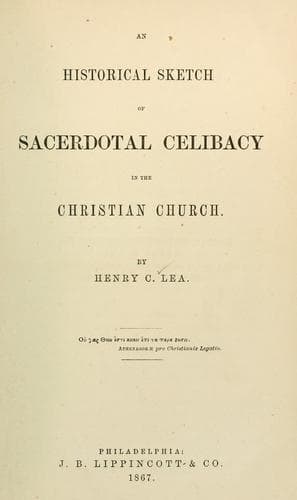
An Historical Sketch of Sacerdotal Celibacy in the Christian ChurchLea, Henry Charles
History
An Historical Sketch of Sacerdotal Celibacy in the Christian Church
Lea, Henry Charles
Catholic Church -- Clergy; Celibacy -- Catholic Church; Church history
Soon after his conversion, Constantine had encouraged the prevailing
tendency by not only repealing the disabilities imposed by the old
Roman law on those who remained unmarried, but by extending the power
of making wills to minors who professed the intention of celibacy.[196]
His piety and that of subsequent emperors speedily attributed to all
connected with the church certain exemptions from the intolerable
municipal burdens which were eating out the heart of the empire.
An enormous premium was thus offered to swell the ecclesiastical
ranks, while, as the number of the officiating clergy was necessarily
limited, the influx would naturally flow into the mass of monks and
nuns on whose increase there was no restriction, and whose condition
was open to all, with but slender examination into the fitness of the
applicant.[197] The rapidly increasing wealth of the church, and the
large sums devoted to the maintenance of all orders of the clergy,
offered additional temptations to those who might regard the life of
the ascetic as the means of securing an assured existence of idleness,
free from all care of the morrow. If, therefore, during a period when
ridicule and persecution were the portion of those who vowed perpetual
continence, it had been found impossible to avoid the most deplorable
scandals,[198] it can readily be conceived that allurements such as
these would crowd the monastic profession with proselytes of a most
questionable character, drawn from a society so frightfully dissolute
as that of the fourth century. The fierce declamations of St. Jerome
afford a terrible picture of the disorders prevalent among those
vowed to celibacy, and of the hideous crimes resorted to in order
to conceal or remove the consequences of guilt, showing that the
asceticism enforced by Siricius had not wrought any improvement.[199]
The necessity of subjecting those bound by vows to established rules
must therefore have soon become generally recognized; and although
as we have already seen, they were free at any time to abandon the
profession which they had assumed, still, while they remained as
members, the welfare of the church would render all right-minded men
eager to hail any attempt to establish rules of wholesome discipline.
The first authoritative attempt to check disorders of the kind is to be
found in the first council of Carthage, which in 348 insisted that all
who, shunning marriage, elected the better lot of chastity, should live
separate and solitary, and that none should have access to them under
penalty of excommunication; and in 381 the Council of Saragossa sought
to remedy the evil at its root by forbidding virgins to take the veil
unless they could furnish proof that they were at least forty years of
age.[200]
Public-domain text, read in full here on John Shaqi.
Reviews
Reviews
No reviews yet
Be the first to share your thoughts on this work.
Elsewhere in the archive
Join the Discussion
Join the discussion
Sign in to leave a comment or review.
Sign InorCreate an account