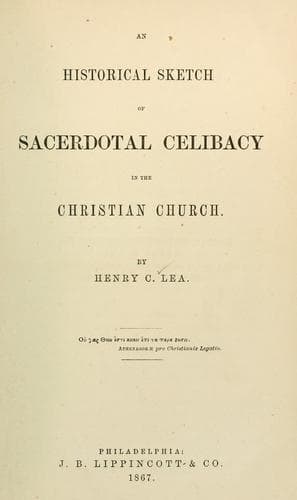
An Historical Sketch of Sacerdotal Celibacy in the Christian ChurchLea, Henry Charles
History
An Historical Sketch of Sacerdotal Celibacy in the Christian Church
Lea, Henry Charles
Catholic Church -- Clergy; Celibacy -- Catholic Church; Church history
Although the church, in becoming an affair of state, had to a great
extent sacrificed its independence, still it enjoyed the countervailing
advantage of being able to call upon the temporal power for assistance
when its own authority was defied, nor was it long in requiring this
aid in the enforcement of its regulations. Accordingly, in 364, we find
a law of Jovian forbidding, under pain of actual or civil death, any
attempt to marry a sacred virgin,[201] the extreme severity of which
is the best indication of the condition of morals that could justify
a resort to penalties so exaggerated. How great was the necessity for
reform, and how little was actually accomplished by these attempts,
may be estimated from an effort of the Council of Valence, in 374,
to prevent those who married from being pardoned after too short a
penance,[202] and from the description which ten years later Pope
Siricius gives of the unbridled and shameless license indulged in by
both sexes in violation of their monastic vows.[203]
* * * * *
Certain definite rules for the governance of these constantly
increasing crowds of all stations, conditions, and characters, who were
obviously so ill-fitted for the obligations which they had assumed,
became of course necessary, but it was long before they assumed an
irrevocable and binding force. The treatise which is known as the
rule of St. Oriesis is only a long and somewhat mystic exhortation to
asceticism. That which St. Pachomius is said to have received from an
angel is manifestly posterior to the date of that saint, and probably
belongs to the commencement of the fifth century. Minute as are its
instructions, and rigid as are its injunctions respecting every action
of the cenobite, yet it fully displays the voluntary nature of the
profession and the lightness of the bonds which tied the monk to his
order. A stranger applying for admission to a monastery was exposed
only to a probation of a few days, to test his sincerity and to prove
that he was not a slave; no vows were imposed, only his simple promise
to obey the rules being required. If he grew tired of ascetic life,
he departed, but he could not be again taken back without penitence
and the consent of the archimandrite.[204] Even female travellers
applying for hospitality were not refused admittance, and an inclosure
was set apart for them, where they were entertained with special honor
and attention; a place was likewise provided for them in which to be
present at vespers.[205]
Public-domain text, read in full here on John Shaqi.
Reviews
Reviews
No reviews yet
Be the first to share your thoughts on this work.
Elsewhere in the archive
Join the Discussion
Join the discussion
Sign in to leave a comment or review.
Sign InorCreate an account