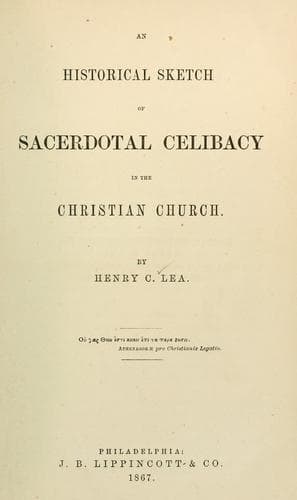
An Historical Sketch of Sacerdotal Celibacy in the Christian ChurchLea, Henry Charles
History
An Historical Sketch of Sacerdotal Celibacy in the Christian Church
Lea, Henry Charles
Catholic Church -- Clergy; Celibacy -- Catholic Church; Church history
A similar system of discipline is manifested in the detailed statement
of the regulations of the Egyptian monasteries left us by John
Cassianus, Abbot of St. Victor of Marseilles, who died in 448. No vows
or religious ceremonies were required of the postulant for admission.
He was proved by ten days’ waiting at the gate, and a year’s probation
inside, yet the slender tie between him and the community is shown by
the preservation of his worldly garments, to be returned to him in
case of his expulsion for disobedience or discontent, and also by the
refusal to receive from him the gift of his private fortune—although no
one within the sacred walls was permitted to call the simplest article
his own—lest he should leave the convent and then claim to revoke his
donation, as not unfrequently happened in institutions which neglected
this salutary rule.[206] So, in a series of directions for cenobitic
life, appended to a curious Arabic version of the Nicene canons, the
punishment provided for persistent disobedience and turbulence is
expulsion of the offender from the monastery.[207]
As a temporary refuge from the trials of life, where the soul could
be strengthened by seclusion, meditation, peaceful labor, and rigid
discipline, thousands must have found the institution of Monachism most
beneficial who had not resolution enough to give themselves up to a
life of ascetic devotion and privation. These facilities for entrance
and departure, however, only rendered more probable the admission of
the turbulent and the worldly; and the want of stringent and effective
regulations must have rendered itself every day more apparent, as the
holy multitudes waxed larger and more difficult to manage, and as the
empire became covered with wandering monks, described by St. Augustin
as beggars, swindlers, and peddlers of false relics, who resorted to
the most shameless mendacity to procure the means of sustaining their
idle and vagabond life.[208]
Public-domain text, read in full here on John Shaqi.
Reviews
Reviews
No reviews yet
Be the first to share your thoughts on this work.
Elsewhere in the archive
Join the Discussion
Join the discussion
Sign in to leave a comment or review.
Sign InorCreate an account