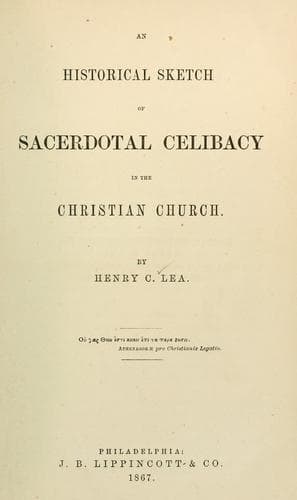
An Historical Sketch of Sacerdotal Celibacy in the Christian ChurchLea, Henry Charles
History
An Historical Sketch of Sacerdotal Celibacy in the Christian Church
Lea, Henry Charles
Catholic Church -- Clergy; Celibacy -- Catholic Church; Church history
It was this, no doubt, which led to the adoption and enforcement of the
third of the monastic vows—that of obedience—as being the only mode by
which during the period when residence was voluntary, the crowds of
devotees could be kept in a condition of subjection. To what a length
this was carried, and how completely the system of religious asceticism
succeeded in its object of destroying all human feeling, is well
exemplified by the shining example of the holy Mucius, who presented
himself for admission in a monastery, accompanied by his child, a boy
eight years of age. His persistent humility gained for him a relaxation
of the rules, and father and son were admitted together. To test
his worthiness, however, they were separated, and all intercourse
forbidden. His patience encouraged a further trial. The helpless child
was neglected and abused systematically, but all the perverse ingenuity
which rendered him a mass of filth and visited him with perpetual
chastisement failed to excite a sign of interest in the father. Finally
the abbot feigned to lose all patience with the little sufferer’s
moans, and ordered Mucius to cast him in the river. The obedient monk
carried him to the bank and threw him in with such promptitude that the
admiring spectators were barely able to rescue him. All that is wanting
to complete the hideous picture is the declaration of the abbot that
in Mucius the sacrifice of Abraham was completed.[209] This epitomizes
the whole system—the transfer to man of the obedience due to God—and
shows how little, by this time, was left of the hopeful reliance on a
beneficent God which distinguished the primitive church, and which led
Athenagoras, in the second century, to argue from the premises “God
certainly impels no one to those things which are unnatural.”
Public-domain text, read in full here on John Shaqi.
Reviews
Reviews
No reviews yet
Be the first to share your thoughts on this work.
Elsewhere in the archive
Join the Discussion
Join the discussion
Sign in to leave a comment or review.
Sign InorCreate an account