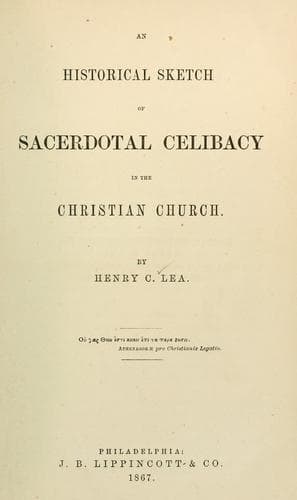
An Historical Sketch of Sacerdotal Celibacy in the Christian ChurchLea, Henry Charles
History
An Historical Sketch of Sacerdotal Celibacy in the Christian Church
Lea, Henry Charles
Catholic Church -- Clergy; Celibacy -- Catholic Church; Church history
The weaker sex, whether from the greater value attached to the purity
of woman or from her presumed frailty, as well as from some difference
in the nature of the engagement entered into, was the first to become
the subject of distinct legislation, and the frequency of the efforts
required shows the difficulty of enforcing the rule of celibacy and
chastity. Allusion has already been made to a law of Jovian which, as
early as 364, denounced the attempt to marry a nun as a capital crime.
Subsequent canons of the church show that this was wholly ineffectual.
The council of Valence, in 374, endeavored to check such marriages.
The synod of Rome, in 384, alludes with horror to these unions,
which it stigmatizes as adultery, and drawing a distinction between
virgins professed and those who had taken the veil, it prescribes an
indefinite penance before they can be received back into the church,
but at the same time it does not venture to order their separation
from their husbands.[210] A year later, the bolder Siricius commands
both monks and nuns guilty of unchastity to be imprisoned, but he
makes no allusion to marriage.[211] Notwithstanding the fervor of St.
Augustin’s admiration for virginity and the earnestness with which he
waged war in favor of celibacy, he pronounces that the marriage of nuns
is binding, ridicules those who consider it as invalid, and deprecates
the evil results of separating man and wife under such circumstances,
but yet his asceticism, satisfied with this concession to common sense,
pronounces such unions to be worse than adulterous.[212] From this it
is evident that these infractions of discipline were far from uncommon,
and that the stricter churchmen already treated such marriages as null
and void, which resulted in the husbands considering themselves at
liberty to marry again. Such view of monastic vows was not sustained
by the authorities of the church, for about the same period Innocent
I., like St. Augustin, while condemning such marriages as worse than
adulterous, admitted their validity by refusing communion to the
offenders until one of the partners in guilt should be dead; and,
like the synod of 384, he considered the transgression as somewhat
less culpable in the professed virgin than in her who had consummated
her marriage with Christ by absolutely taking the veil.[213] It was
probably this assumed marriage with Christ—a theory which St. Cyprian
shows to be as old as the third century, and which is very strongly
stated by Innocent—which rendered the church so much more sensitive
as to the frailty of the female devotees than to that of the men. As
yet, however, the stability of such marriages was generally accepted
throughout the church, for, a few years before the epistle of Innocent
we find it enunciated by the first council of Toledo, which decided
that the nun who married was not admissible to penitence during the
life of her husband, unless she separated herself from him.[214]
Public-domain text, read in full here on John Shaqi.
Reviews
Reviews
No reviews yet
Be the first to share your thoughts on this work.
Elsewhere in the archive
Join the Discussion
Join the discussion
Sign in to leave a comment or review.
Sign InorCreate an account