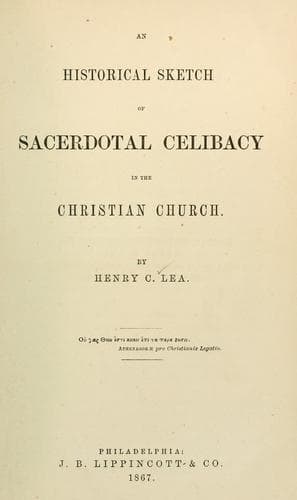
An Historical Sketch of Sacerdotal Celibacy in the Christian ChurchLea, Henry Charles
History
An Historical Sketch of Sacerdotal Celibacy in the Christian Church
Lea, Henry Charles
Catholic Church -- Clergy; Celibacy -- Catholic Church; Church history
It is evident from all this that an effort had been made to have
such marriages condemned as invalid, and that it had failed. We see,
however, that the lines had gradually been drawn more tightly around
the monastic order, that the vows could no longer be shaken off with
ease, and that there was a growing tendency to render the monastic
character ineffaceable when once assumed. Towards the middle of the
fifth century, however, a reaction took place, possibly because the
extreme views may have been found impracticable. Thus Leo I. treats
recalcitrant cenobites with singular tenderness. He declares that monks
cannot without sin abandon their profession, and therefore that he who
returns to the world and marries must redeem himself by penitence, for
however honorable be the marriage-tie and the active duties of life,
still it is a transgression to desert the better path. So professed
virgins, who throw off the habit and marry, violate their duty, and
those who in addition to this have been regularly consecrated commit a
great crime—and yet no further punishment is indicated for them;[215]
and the little respect still paid to the indelible character claimed
for monachism is shown by the manner in which the civil power was ready
to interfere for the purpose of putting an end to some of the many
abuses arising from monastic institutions. In 458 Majorian promulgated
a law in which he inveighs with natural indignation against the parents
who, to get rid of their offspring, compel their unhappy daughters to
enter convents at a tender age, and he orders that, until the ardor of
the passions shall be tempered by advancing years, no vows shall be
administered. The minimum age for taking the veil is fixed at forty
years and stringent measures are provided for insuring its observance.
If infringed by order of the parents, or by an orphan girl of her
own free will, one-third of all the possessions of the offender is
confiscated to the state, and the ecclesiastics officiating at the
ceremony are visited with the heavy punishment of proscription. A woman
forced into a nunnery, if her parents die before she reaches the age
of forty, is declared to be free to leave it and to marry, nor can she
be disinherited thereafter.[216] Fruitless as this well-intentioned
effort proved, it is highly suggestive as to the wrongs which were
perpetrated under the name of religion, the stern efforts felt to be
requisite for their prevention, and the power exercised to annul the
vows.
* * * * *
Public-domain text, read in full here on John Shaqi.
Reviews
Reviews
No reviews yet
Be the first to share your thoughts on this work.
Elsewhere in the archive
Join the Discussion
Join the discussion
Sign in to leave a comment or review.
Sign InorCreate an account