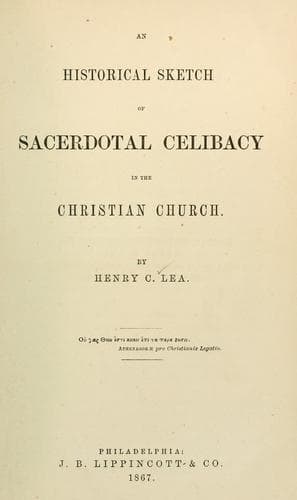
An Historical Sketch of Sacerdotal Celibacy in the Christian ChurchLea, Henry Charles
History
An Historical Sketch of Sacerdotal Celibacy in the Christian Church
Lea, Henry Charles
Catholic Church -- Clergy; Celibacy -- Catholic Church; Church history
In the East, the tendency was to give a more rigid and unalterable
character to the vows, nor is it difficult to understand the cause.
Both church and state began to feel the necessity of reducing to
subjection under some competent authority the vast hordes of idle and
ignorant men who had embraced monastic life. In the West, monachism
was as yet in its infancy, and was to be stimulated rather than to be
dreaded, but it was far otherwise in the East, where the influence
of the ascetic ideas of India was much more direct and immediate.
The examples of Antony and Pachomius had brought them innumerable
followers. The solitudes of the deserts had become peopled with vast
communities, and as the contagion spread, monasteries arose everywhere
and were rapidly filled and enlarged.[217] The blindly bigoted and the
turbulently ambitious found a place among those whose only aim was
retirement and peace; while the authority wielded by the superior of
each establishment, through the blind obedience claimed under monastic
vows, gave him a degree of power which rendered him not only important
but dangerous. The monks thus became in time a body of no little weight
which it behooved the church to thoroughly control, as it might become
efficient for good or evil. By encouraging and directing it, she
gained an instrument of incalculable force, morally and physically, to
consolidate her authority and extend her influence. How that influence
was used, and how the monks became at times a terror even to the state
is written broadly on the history of the age. Even early in the fifth
century the hordes of savage Nitrian cenobites were the janizaries of
the fiery Cyril, with which he lorded it over the city of Alexandria,
and almost openly bade defiance to the imperial authority. The tumult
in which Orestes nearly lost his life, the banishment of the Jews, and
the shocking catastrophe of Hypatia show how dangerous an element to
society they were even then, when under the guidance of an able and
unscrupulous leader.[218] So the prominent part taken by the monks
in the deplorable Nestorian and Eutychian controversies, the example
of the Abbot Barsumas at the Robber Synod in Ephesus, the exploits
of Theodosius of Jerusalem and Peter of Antioch, who drove out their
bishops and usurped the episcopal chairs, the career of Eutyches
himself, the bloodthirsty rabble of monks who controlled the synod
of Ephesus and endeavored to overawe that of Chalcedon, and, in the
succeeding century, the insurrections against the Emperor Anastasius
which were largely attributed to their efforts—all these were warnings
not lightly to be neglected. The monks, in fact, were fast becoming
not only disagreeable but even dangerous to the civil power; their
organization and obedience to their leaders gave them strength to
seriously threaten the influence even of the hierarchy, and the effort
to keep them strictly under subjection and within their convent walls
Public-domain text, read in full here on John Shaqi.
Reviews
Reviews
No reviews yet
Be the first to share your thoughts on this work.
Elsewhere in the archive
Join the Discussion
Join the discussion
Sign in to leave a comment or review.
Sign InorCreate an account