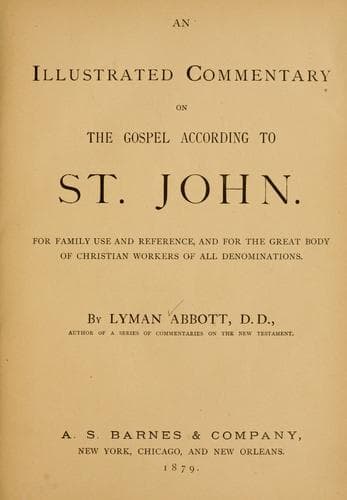
An illustrated commentary on the Gospel according to St. JohnAbbott, Lyman
Religion
An illustrated commentary on the Gospel according to St. John
Abbott, Lyman
Bible. John -- Commentaries
heathen colony was then sent in to take the places of the exiled
Israelites; these colonists suffered from the devastations of wild
beasts, and acting on the common assumption of that time that their
own gods were not competent to take care of them in a strange land,
sent for and received priests of Israel to teach them the manner of
the God of Palestine. The result of this instruction was a mixed
religion, partly Jewish, partly heathen (2 Kings 17:24-41). In the O.
T., the phrase “the cities of Samaria,” is equivalent to the “kingdom
of Israel;” it thus included all of Palestine north of Judea. That
portion of Israel east of the Jordan which originally belonged to it
was subsequently taken away the kings of Assyria (1 Chron. 5:26),
Galilee shared the same fate (2 Kings 15:29), and Samaria was reduced
to the dimensions which it possessed in the time of Christ. The
character and conduct of the Samaritans increased the antagonism
between them and the Jews. They were refused permission to participate
in the rebuilding of the temple at Jerusalem, at the time of the
return of Judah from captivity, and became open, and, for a time,
successful opponents of the rebuilding (Ezra, chaps. 4 and 5; Neh.,
chaps. 4 and 6). Finally, an exiled priest from Jerusalem obtained
permission from the Persian king of his day to build a rival temple at
Gerizim, and Samaria became the rival of Jerusalem, and the
rallying-point of its foes and its outlaws (Josephus’ Antiq. 11:8, 6).
To a rival temple and religion, they added a Samaritan Pentateuch, for
which they claimed a greater antiquity and authority than for any copy
of the O. T. possessed by the Jews. The bitter national and religious
antipathy between Jew and Samaritan, consequent upon this history, is
illustrated in several passages in the N. T. (ver. 9, note; 8:48; Luke
9:52-56; 10:30-37; 17:16). If anything could justify such an antipathy
this would be justified, since the Samaritans were renegades both to
their religion and to their nation; and Christ’s course here and
elsewhere implies a condemnation of all rancor and bitterness, founded
on race, national, or religious differences. Of the Samaritans, one
hundred and fifty still worshipping in a little synagogue at the foot
of Gerizim are all that are left, “the oldest and the smallest sect in
the world.”
5 Then cometh he to a city of Samaria, which is called
Sychar, near to the parcel of ground that Jacob gave[126]
to his son Joseph.
[126] Gen. 33:19; 48:22; Josh. 24:32.
Public-domain text, read in full here on John Shaqi.
Reviews
Reviews
No reviews yet
Be the first to share your thoughts on this work.
Elsewhere in the archive
Join the Discussion
Join the discussion
Sign in to leave a comment or review.
Sign InorCreate an account