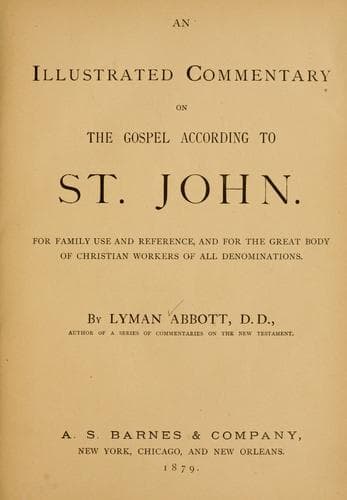
An illustrated commentary on the Gospel according to St. JohnAbbott, Lyman
Religion
An illustrated commentary on the Gospel according to St. John
Abbott, Lyman
Bible. John -- Commentaries
=The external evidence.= Those who expect to find a demonstration
of the Johannine authorship of the Fourth Gospel in the external
evidences, will be disappointed. The literature of the first three
centuries does not afford a demonstration of authorship of any ancient
book. But the authorship of John’s Gospel I believe to be as well
established, on a fair consideration of all the evidence, external and
internal, as that of any work of the same era.
It is not questioned by any one that at the beginning of the third
century the Fourth Gospel was in general use in the churches, and
universally recognized as written by the Apostle John. Eusebius,
Origen, Tertullian, Clement of Alexandria, are among those who bear
testimony to this fact. The Fourth Gospel is recognized as John’s
composition in the canon of Muratori, A. D. 175; and by Irenæus, who
died about 202, and who was a pupil of Polycarp, himself a pupil of
John. References to sayings of Jesus reported only by John are also
found in the writings of Tatian, A. D. 170, Justin Martyr, A. D.
120-160, and the various Gnostic writers of the second century. These
references do not conclusively prove the Johannine authorship of the
Fourth Gospel, for these earliest writers are not accustomed to give
the names of authors from whom they quote; but they do conclusively
prove that as early as the first part of the second century, sayings of
Christ, found only in the Fourth Gospel, were attributed by the Church
to Jesus. The best report of these quotations which I have seen is to
be found in the second volume of “Supernatural Religion,” and they
are there the more effective because the author in vain endeavors to
break their force, by what most readers will consider an ingenious but
ineffective special pleading. Let the reader compare these quotations
with the parallel passages in the Fourth Gospel; he will not doubt that
the later writers borrowed from the earlier one. The only alternative
is the irrational hypothesis that both borrowed from the same source
and one generally recognized in the primitive Church; in other words,
that there was a Gospel containing the same matter that is now found
in the Fourth Gospel, but that it has so entirely disappeared that no
tradition even of its existence has survived, and that in its place a
forgery has been palmed off upon the Church so successfully, that in
the beginning of the third century it was universally accepted as the
original work of the Apostle whose name it has ever since borne.
Public-domain text, read in full here on John Shaqi.
Reviews
Reviews
No reviews yet
Be the first to share your thoughts on this work.
Join the Discussion
Join the discussion
Sign in to leave a comment or review.
Sign InorCreate an account