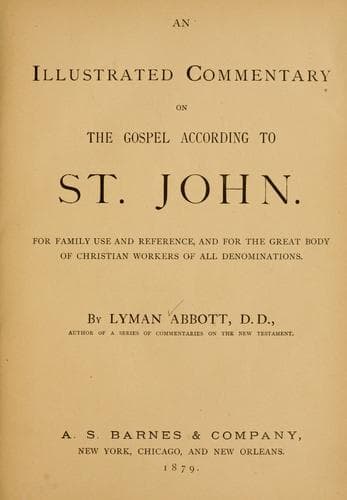
An illustrated commentary on the Gospel according to St. John — John Shaqi
An illustrated commentary on the Gospel according to St. JohnAbbott, Lyman
Religion
An illustrated commentary on the Gospel according to St. John
Abbott, Lyman
Bible. John -- Commentaries
Space does not allow me to give in detail these quotations, which are
numerous; it would be still more out of the province of this
introduction to enter into the arguments by which the rationalistic
writers endeavor to reconcile these quotations with their hypotheses.
I can but briefly indicate a few of them, referring the student to the
larger works for the examination in detail of the parallelism between
these early ecclesiastical writers and the Fourth Gospel. Justin
Martyr thus refers to the testimony of John the Baptist: “I am not the
Christ ... for he cometh who is stronger than I, whose shoes I am not
meet to bear” (comp. John 1:19-27). He cites Christ as saying, “Unless
ye be born again, ye shall not enter into the kingdom of heaven,” and
adds the comment, “Now that it is impossible for those who have been
born to go into the matrices of the mother is evident to all” (comp.
John 3:3-5). Tatian refers to the sayings, “The darkness comprehends
not the light” (comp. John 1:5), and “All things were by him, and
without him was not anything made” (comp. John 1:5, 3). Hegessippus
(A. D. 125) refers to “that which is spoken in the Gospels, ‘That was
the true light which lighteth every man who cometh into the world’”
(comp. John 1:9). In the writings of the Naaseni and Peratæ, Gnostic
sects of the beginning of the second century, we have several
unmistakable references to sayings that are peculiar to the Fourth
Gospel. “I am the door,” (comp. John 10:7); “As Moses lifted up the
serpent in the wilderness, even so must the Son be lifted up,” (comp.
John 3:14); “If thou hadst known who it is that asketh thee, thou
wouldest have asked of him, and he would have given thee living water,
springing up,” (comp. John 4:10); “The Saviour hath said, ‘That which
is born of flesh is flesh, and that which is born of the Spirit is
spirit,’” (comp. John 3:6); “Except ye eat my flesh and drink my
blood, ye shall not enter the kingdom of heaven,” (comp. John 6:53).
These are by no means all the citations from the writers of the first
two centuries which appear to have been taken from the Fourth Gospel,
but they will suffice to give the reader an idea of the nature of the
evidence which is regarded by most Christian writers, and by some
rationalistic critics--Matthew Arnold, for example--as establishing
the fact that the Fourth Gospel was in existence and recognized as an
authority in the Church in the beginning of the second century. If
this is the fact, it is reasonably certain that it was the work of the
Apostle John, since if it had been written by any one else as early as
that date, that is, during the lifetime of some of the contemporaries
of John, the forgery would certainly have been detected.
Public-domain text, read in full here on John Shaqi.
Reviews
Reviews
No reviews yet
Be the first to share your thoughts on this work.
Join the Discussion
Join the discussion
Sign in to leave a comment or review.
Sign InorCreate an account