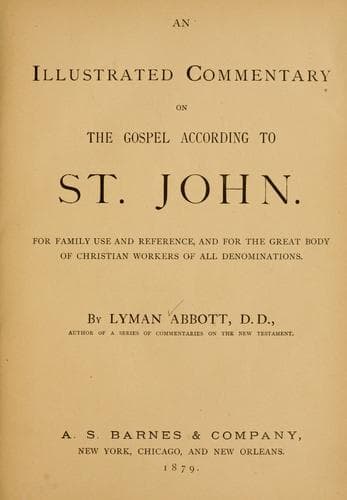
An illustrated commentary on the Gospel according to St. JohnAbbott, Lyman
Religion
An illustrated commentary on the Gospel according to St. John
Abbott, Lyman
Bible. John -- Commentaries
=19, 20. The woman saith unto him.= Her sentence is incomplete, either
in the utterance or in the report. It is the basis of a question,
implied, or perhaps expressed, but not given by John, in which place
should worship be offered; which were right, Jew or Samaritan. The
question was one fiercely debated between them (See on verse 5).--=I
perceive that thou art a prophet.= It was a hasty conclusion; Christ
might have known her character and life by other than supernatural
means. Bigotry and vice are apt to be credulous and superstitious.
Observe, however, the difference in tone between this declaration and
the language of verse 9: “How is it that thou being a Jew.”--=Our
fathers worshipped.= “The argument of ‘our fathers’ has always proved
strong. Opinions, like electricity, are supposed to descend more
safely along an unbroken chain. That which ‘our fathers’ or our
ancestors believed, is apt to seem necessarily true; and the larger
the roots of any belief, the more flourishing, it is supposed, will be
its top.”--(_Beecher._) Calvin’s comments are admirable though too
long to quote. He suggests four errors into which men are apt to fall,
from blindly following the “_fathers_,” all illustrated by the
Samaritans: (1) When pride has created a false custom or religion, the
history of the fathers is ransacked to find justification for it; (2)
when men imitate the example of the evil-doers, because they are
ancient, forgetful that they only are worthy to be reckoned as fathers
who are true sons of God; (3) when we imitate the conduct but not the
spirit of the fathers, as if one should defend human sacrifice
from the example of Abraham in Gen. 22:1-10; (4) when we imitate
the conduct of the fathers without considering the change of
circumstances, as when the Christian church attempts to copy the
ceremonials of the Jewish. “None of these are true imitators of the
fathers; most of them are apes.”--=In this mount=, Gerizim. According
to the Samaritan tradition it was here that Abraham went to sacrifice
Isaac; and here, not on Ebal, as according to our Scripture (Josh.
8:30; Deut. 27:4), that the altar was erected by Joshua on which the
words of the law were inscribed. The first view is sanctioned by some
Christian scholars, prominent among whom is Dean Stanley. A temple was
built on Gerizim by the Samaritans, according to Josephus, during the
reign of Alexander, though the date is doubtful. The two temples
intensified the bitterness of the feud between the Jews and the
Samaritans, and the Samaritan temple was deserted and destroyed, B. C.
129, by John Hyrcanus (Josephus’ Antiquities 13:9, 11); but the
Samaritans at Sechem (Nablus) still call Gerizim the holy mountain,
and turn their faces toward it in prayer.--=Ye say.= She still treats
Christ as a Jew.
Public-domain text, read in full here on John Shaqi.
Reviews
Reviews
No reviews yet
Be the first to share your thoughts on this work.
Elsewhere in the archive
Join the Discussion
Join the discussion
Sign in to leave a comment or review.
Sign InorCreate an account