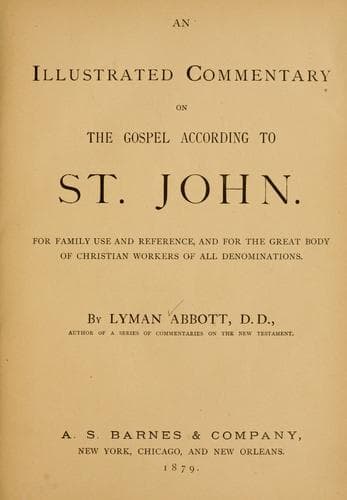
An illustrated commentary on the Gospel according to St. JohnAbbott, Lyman
Religion
An illustrated commentary on the Gospel according to St. John
Abbott, Lyman
Bible. John -- Commentaries
the remote future for the fulfillment of this word. Already the day
has dawned, though it has not fully arrived. Her language in verse 25
indicates that a suspicion of Christ’s true nature was, perhaps by
this declaration, awakened in her.--=When the true worshippers.= Not
merely the sincere in opposition to consciously hypocritical
worshippers (Isaiah 29:13), but also the true, inward worshippers, in
opposition to those whose worship was one of external form and
therefore not genuine. The word _true_ is elsewhere used thus by John
to indicate the inward and spiritual as contrasted with the external
and earthly, _e. g._, the true light (1:9), the true bread (6:32), the
true vine (15:1). Compare Luke 16:11.--=Shall worship the Father=, and
therefore know what they worship; =in spirit and in truth=. Not in the
Holy Spirit, though it is true that all spiritual worship is inspired
and directed by his influence (Rom. 8:26; Zach. 12:10); nor with the
breathing and aspirations of the heart, in contrast to worship with
outward forms and symbols, for symbol is necessary in all public
worship, language is but an external symbol of inward feeling; nor in
holiness and righteousness of life, for that is not the meaning of
_spirit_; nor in soundness of faith, in contrast to heretical worship,
for the worship of the Jews was not heretical, Christ has just said,
“We know what we worship.” _In_ (ἐν) expresses not the instrument with
which the worship shall be conducted, but the atmosphere in which it
will live, an atmosphere of spiritual life and truth; worship _in
spirit_, is in contrast with a worship in the flesh, the essence of
which consists in the rite, the form, the language, the posture (Comp.
Rom. 12:1; Phil. 3:3, 4; Heb. 9:9, 24); worship _in truth_ is one
which in its character harmonizes with the nature of him who is
worshipped. The Lycaonians would have worshipped Paul and Barnabas
(Acts 14:11-13) in sincerity, but not in truth. Christ’s language
condemns the spirit of ritualism, but not the employment of
rites.--=For the Father is seeking such to worship him.= God is
represented as in quest of such worshippers, among the many who are
worshippers merely in form. Observe _work is not_ worship; God is
seeking not merely workers (Matt. 20:1) but also worshippers (Comp.
Luke 10:38-42, notes).--=God is a Spirit.= This declaration is
fundamental, and radically inconsistent with (1) all scientific
theories which represent him as an abstract impersonal force; (2) with
all metaphysical refinements which, ignoring his personality, treat
him as a “power that makes for righteousness,” or as “the highest
dream of which the human soul is capable;” (3) with much of the
received theology, which often assumes that God is like nature, and
deduces his attributes from such an imaginary likeness; (4) with all
idolatry, whether the idol be in the imagination or in wood, stone, or
canvas. But it justifies us in looking to man’s spiritual nature to
Public-domain text, read in full here on John Shaqi.
Reviews
Reviews
No reviews yet
Be the first to share your thoughts on this work.
Elsewhere in the archive
Join the Discussion
Join the discussion
Sign in to leave a comment or review.
Sign InorCreate an account