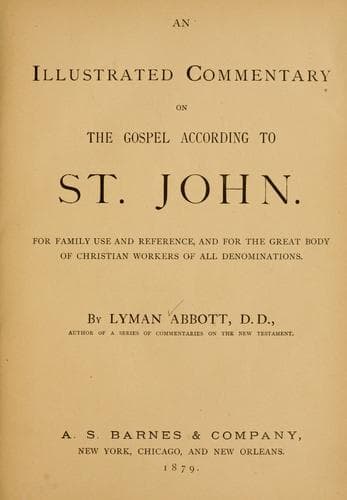
An illustrated commentary on the Gospel according to St. JohnAbbott, Lyman
Religion
An illustrated commentary on the Gospel according to St. John
Abbott, Lyman
Bible. John -- Commentaries
Ch. 4:27-42. CHRIST IN SAMARIA.--THE SUSTENANCE OF CHRISTIAN
LABORERS.--THE CALL FOR CHRISTIAN LABORERS.--THEIR REWARD.--THEIR
SUCCESS.
27 And upon this came his disciples, and marvelled that
he talked with the woman: yet no man said, What seekest
thou? or, Why talkest thou with her?
28 The woman then left her waterpot, and went her way into
the city, and saith to the men,
29 Come, see a man, which told me all things that ever I
did: is not this the Christ?
30 Then they went out of the city, and came unto him.
=27-30. And marvelled that he talked with a woman.= There is no
definite article in the original. The disciples knew nothing of the
woman’s character except that she was a Samaritan. What amazed them
was that Christ should descend to instruct a woman at all, and
especially a woman of Samaria. See above on ver. 4.--=No man said,
What seekest thou?= One of the many indications in the Gospel of the
awe in which these life-companions of Christ stood toward him (Mark
9:32; 10:32; 16:8; Luke 8:25; John 21:12).--=Left her waterpot.=
Lightfoot supposes in kindness, for the Lord to use; Calvin, with
greater probability, in her haste forgetting it. In her eagerness to
carry to others the news of the Messiah, she forgets her original
errand, which was to draw water for her home.--=Come see a man.=
Compare ch. 1:39, 46.--=Which told me all things that ever I did.= The
natural exaggeration of enthusiasm. Observe the method of the spread
of Christianity in its earliest years. The new convert became a
missionary, propagating its faith. Compare Acts 8:4; 9:20. If ever a
new convert might be excused from evangelical labors, this one
might--a woman, living in an age when female preaching was more
obnoxious even than now, and a woman of such ill-repute that she might
well expect to be received with scorn, not with respect. But her
strong convictions overbear all obstacles, secure for her a hearing,
and obtain for her mission success (ver. 39). Chrysostom dwells upon
her wisdom as well as her eagerness: “She said not, Come, see the
Christ, but, with the same condescension with which Christ had netted
her, she draws the men to Him; Come, she saith, see a man who told me
all that ever I did. Is not this the Christ? Observe again here the
great wisdom of the woman; she neither declared the fact plainly, nor
was she silent; for she desired not to bring them in by her own
assertion, but to make them to share in this opinion by hearing him. *
* * Nor did she say, Come, believe, but Come, _see_, a gentler
expression than the other, and one which more attracted them.”--=Then
they came out of the city.= Wisdom and tact inspired by enthusiasm
produced by a personal and profound conviction of Christ’s person and
power, rarely fail in evangelical labor.
31 In the mean while his disciples prayed him, saying,
Master, eat.
32 But he said unto them, I have meat to eat that ye know
not of.
Public-domain text, read in full here on John Shaqi.
Reviews
Reviews
No reviews yet
Be the first to share your thoughts on this work.
Elsewhere in the archive
Join the Discussion
Join the discussion
Sign in to leave a comment or review.
Sign InorCreate an account