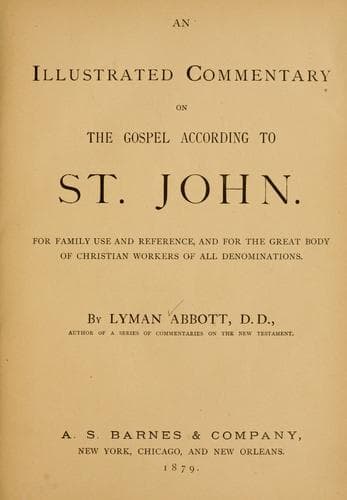
An illustrated commentary on the Gospel according to St. JohnAbbott, Lyman
Religion
An illustrated commentary on the Gospel according to St. John
Abbott, Lyman
Bible. John -- Commentaries
=43-45. After two days.= Spent in preaching the gospel to the
Samaritans. The nature of this ministry is left to conjecture. We must
presume, however, that it was of the same type as Christ’s preaching
in Galilee at this time, where his theme was, “Repent, for the kingdom
of heaven is at hand” (Matt. 4:17); the nature of that kingdom, and
the character of the Messianic king, he probably made no attempt to
explain. It was preparative; he sowed only, leaving the reaping to be
done by others at a later day.--=For Jesus himself testified that a
prophet hath no honor in his own country.= The rationalistic critics
cite this as one of the evidences that the Fourth Gospel is not the
product of one of the Twelve. Thus, “In the Synoptics Jesus is
reported as quoting against the people of his own city, Nazareth, who
rejected him, the proverb, ‘A prophet has no honor in his own country’
(Matt. 13:57; Mark 6:4; Luke 4:24). The appropriateness of the remark
here is obvious. The author of the Fourth Gospel, however, shows
clearly that he was neither an eye-witness nor acquainted with the
subject or country when he introduces this proverb in a different
place. * * * * * He (Christ) is made to go into Galilee, which is his
own country, because a prophet has no honor in his country, and the
Galileans are represented as receiving him, which is a contradiction
of the proverb.”--(_Supernatural Religion_, Vol. II, 447.) I have
cited this objection at length because it is a not unfair illustration
of the straits to which rationalism is reduced in its efforts
to discredit this Gospel. Constructive dogmatism is bad enough;
destructive dogmatism is much worse. The difficulties created by
evangelical critics in the interpretation of the passage are equally
curious as an illustration of forced and fanciful exaggerations. The
curious will find them stated in Alford and Meyer. The English reader,
who simply takes the context, will assuredly find no difficulty in the
passage. Christ was received in Samaria, notwithstanding he was a Jew,
with whom usually the Samaritans had no dealings (ver. 9), and this
though he wrought no miracles, and merely because of his words, _i.
e._, the purity and beauty and self-evident truth of his teaching
(ver. 41).--In Galilee he was received only because he was a Jew, and
had wrought miracles at Jerusalem (chap. 3:2), and brought with him a
metropolitan reputation. He had no honor in his own country as a
prophet, until he brought it back with him from the holy city; it was
honor, not indigenous but imported.
46 So Jesus came again into Cana of Galilee, where he
made[154] the water wine. And there was a certain nobleman,
whose son was sick at Capernaum.
[154] ch. 2:1, 11.
47 When he heard that Jesus was come out of Judæa into
Galilee, he went unto him, and besought him that he would
come down, and heal his son: for he was at the point of
death.
Public-domain text, read in full here on John Shaqi.
Reviews
Reviews
No reviews yet
Be the first to share your thoughts on this work.
Elsewhere in the archive
Join the Discussion
Join the discussion
Sign in to leave a comment or review.
Sign InorCreate an account