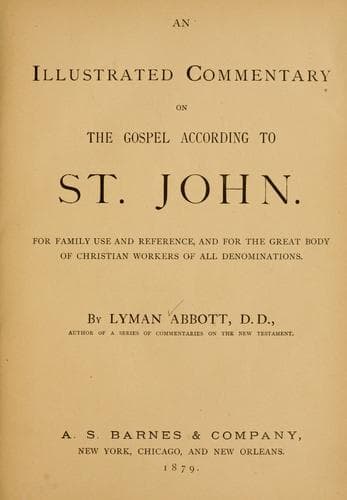
An illustrated commentary on the Gospel according to St. JohnAbbott, Lyman
Religion
An illustrated commentary on the Gospel according to St. John
Abbott, Lyman
Bible. John -- Commentaries
=18. Because he had not only broken the Sabbath.= Literally _relaxed_
(λύω) the Sabbath. See note on Matt. 5:19 for meaning of the word. The
Pharisees then, as the literalists now, believe that the sanctity of
the Sabbath could only be preserved by putting the soul under bonds to
a literal compliance with specific regulations. Christ broke these
bonds asunder, gave the soul liberty, and preserved the Sabbath by
inspiring the souls of his disciples with allegiance to himself, love
for humanity, and sympathy with the redeeming work of the Father. He
did relax what they supposed to be essential to the preservation of
the day, but what was really destroying it. To keep this poor man on
his bed, or watching it to prevent it from being stolen, would have
destroyed for him the rest of the day, in order that he might comply
with the letter of the Pharisaic regulations. So he who rides in a
horse-car rather than remain away from church, or travels late
Saturday night or early Sunday morning rather than destroy his Sabbath
by spending it with strangers, seems to the Sabbatarian of to-day to
be relaxing the Sabbath, while he may be in truth preserving it.--=But
said also that God was his own Father.= (πατέρα ἴδιον.) Norton renders
the sense accurately though freely, _Had spoken of God as particularly
his Father_. The meaning of the original will be indicated to the
English reader by Rom. 8:32, “Spared not _his own_ Son;” 1 Cor. 6:18,
“Sinneth against _his own_ body;” 1 Cor. 7:2, “Have _her own_
husband.” It is clear that the Jews either did understand Christ by
his language to claim peculiar relations with God, or pretended so to
do. In his mere reference to God as Father there was no such claim,
for he bids us all call him our Father (Matt. 6:6, 7). True, in the
language “_my_ Father,” most commentators see a ground for the
interpretation put upon his language by the Judeans:--thus Meyer:
“They rightly interpreted ‘my Father’ as signifying peculiar and
personal fatherhood;” Bengel: “The Only-begotten alone can say, ‘my
Father’;” similarly Alford, Tholuck, and others. There is perhaps some
ground for this view. Yet I can hardly think that Christ’s mere
designation of God as “_my_ Father” implies more than Paul’s “Abba
Father” (Rom. 8:15), which Luther renders “dear Father,” or the
frequent designation of God as _my_ God by the patriarchs, and
especially by David. See for example, Exod. 15:2; 1 Chron. 28:20; 2
Chron. 18:13; Ps. 22:1, 10; 38:21; 71:12; 2 Cor. 12:21; Phil. 4:19.
And in Psalm 89:26; Jer. 3:4, man is directed by God to apply this
very phrase “my Father” in his address to God. I believe then that the
statement that Jesus said that God was _in a peculiar sense_ his
Father, and the deduction that he thus made himself equal to God, are
the malicious wresting of his words by the Judeans, for the very
purpose of finding an occasion of offence. They manifested the same
spirit in John 10:31, etc., though there they have better ground for
Public-domain text, read in full here on John Shaqi.
Reviews
Reviews
No reviews yet
Be the first to share your thoughts on this work.
Elsewhere in the archive
Join the Discussion
Join the discussion
Sign in to leave a comment or review.
Sign InorCreate an account