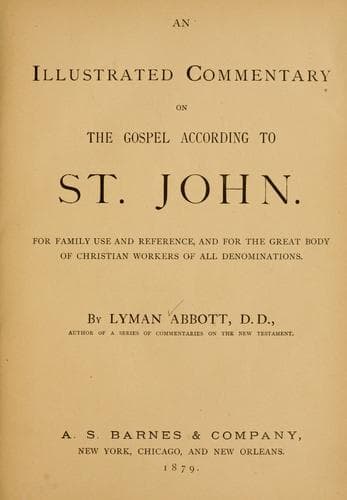
An illustrated commentary on the Gospel according to St. JohnAbbott, Lyman
Religion
An illustrated commentary on the Gospel according to St. John
Abbott, Lyman
Bible. John -- Commentaries
the interpretation which they put upon his words. In the discourse
which follows, Christ does not hold them to their original charge
respecting the Sabbath. He follows them into the new ground which they
have entered on, and expounds his true nature and mission.--=Making
himself equal with God.= “On the same level with God” (_Meyer_); “On
an equality with God” (_Norton_); “Of the same nature and condition”
(_Robinson_). The language of Jesus, his claim of the right to work
because the Father works, and his language _My Father_, the Judeans
regard as embodying an assumption that he is of the divine nature and
possesses the divine prerogatives. That they so interpreted his
language does not prove that it is to be so interpreted. The Pharisees
are not authorized interpreters of the words of Christ. His claim we
must interpret for ourselves from the discourse which follows. How far
does he correct and how far confirm their interpretation? It seems to
me clear that at the very outset he materially modifies it, in his
declaration of his obedience to and dependence upon and work under the
Father (ver. 19), while he confirms the substantial idea that he
possesses the same nature as the Father, is, so to speak, of kin to
Him, by his declaration that he does what the Father does (ver. 19),
shares in all the counsels of the Father (ver. 20), gives life to the
dead as the Father (ver. 21), judges all men for the Father (ver. 22),
is to be honored as the representative of the Father (ver. 23), is the
door through which all must enter into eternal life in the Father
(ver. 24), and is the final Resurrection and Judge for the Father
(ver. 25-29); yet at the close he again emphasizes the truth that in
all this he is not a second or even subordinate God, but the One
through whom the Father does all (ver. 30), the one mediator between
God and man (1 Tim. 2:5).
19 Then answered Jesus and said unto them, Verily, verily,
I say unto you,[174] The Son can do nothing of himself,
but what he seeth the Father do: for what things
soever he doeth, these also doeth the Son likewise.
[174] verse 30.
20 For[175] the Father loveth the Son, and sheweth him all
things that himself doeth: and he will shew him greater
works than these, that ye may marvel.
[175] chaps. 3:35; 17:26; Matt. 3:17.
Public-domain text, read in full here on John Shaqi.
Reviews
Reviews
No reviews yet
Be the first to share your thoughts on this work.
Elsewhere in the archive
Join the Discussion
Join the discussion
Sign in to leave a comment or review.
Sign InorCreate an account