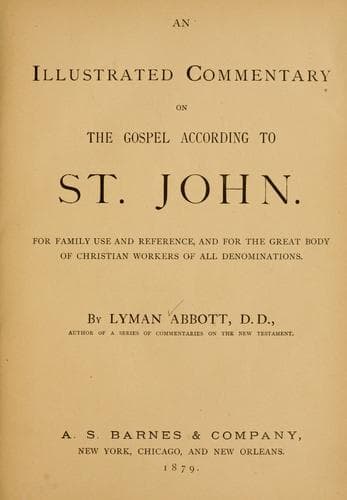
An illustrated commentary on the Gospel according to St. JohnAbbott, Lyman
Religion
An illustrated commentary on the Gospel according to St. John
Abbott, Lyman
Bible. John -- Commentaries
=19, 20. Verily, verily.= A formula used by Christ in cases of
important and emphatic affirmation.--=The Son can do nothing of
himself=, _i. e._, of his own will or authority. “Of myself (ἀφ’
ἑαυτοῦ), _i. e._, of one’s own will or accord, without authority or
command from another.”--(_Rob._ 24, art. ἀπό.) This declaration cannot
be limited, as by Calvin, to the power of Christ in his human nature,
without, adding to the verse what is not in it, nor in its necessary
connection; nor can we read it, as Chrysostom does, that Christ can do
nothing contrary to his Father’s will, because of the perfect union
between them, for this is clearly not the meaning of the original.
Christ says not, I can do nothing contrary to my Father, but, I can do
nothing _of myself_ by my own independent and original power. The
meaning of the original is transparent, though the truth is
transcendent. This is that _the power of Christ is not an original but
a derived power_; that it comes from the Father and is a power only to
do those things which carry out the Father’s will. As the Christian
can do nothing without Christ (ch. 15:5), yet can do all things
through Christ strengthening him (Phil. 4:13), so Christ can do
nothing without the Father, but does all things by virtue of a divine
power imparted to him by the Father, and as a manifestation of the
Father. This is a partial answer to the charge that Christ makes
himself equal to the Father. He show’s that so far from doing anything
calculated to draw away allegiance from the Father, he draws
allegiance to the Father, since in all that he does he acts out only
the Father’s will. He is divine because of the divinity with which he
has, so to speak, been clothed by the Father’s love.--=But what he
seeth the Father do.= “A familiar description, borrowed from the
attention which children give to their father--of the inner and
immediate intention which the Son perpetually has of the Father’s
will, in the perfect consciousness of fellowship of life with
Him.”--(_Meyer._)--=Whatsoever things he doeth, these also doeth the
Son likewise.= _In like manner_ (ὁμοίως), that is, with like power and
authority. This surely could be said of no man, no angel. It indicates
not only a superhuman but also a super-angelic character. Thus this
verse puts in a very compact form the paradox of Christ’s character--a
paradox not to be explained away by either modifications of the first
clause or denials of the second. The first clause asserts that
Christ’s power comes from the Father, and thus, in a sense, is not
equal to that of the Father, which is uncreated and underived. And
with this declaration agree many other passages of Scripture. See for
example, ch. 7:17, 18; 8:42; 14:10; Phil. 2:9; Heb. 1:9; 3:2. The
second clause asserts that this power, conferred upon the Son, is that
of the Father, who has put all things into the hands of the Son that
he may be Lord of all. Acts 10:36; James 5:9; Col. 1:16, 17; 3:11. It
Public-domain text, read in full here on John Shaqi.
Reviews
Reviews
No reviews yet
Be the first to share your thoughts on this work.
Elsewhere in the archive
Join the Discussion
Join the discussion
Sign in to leave a comment or review.
Sign InorCreate an account