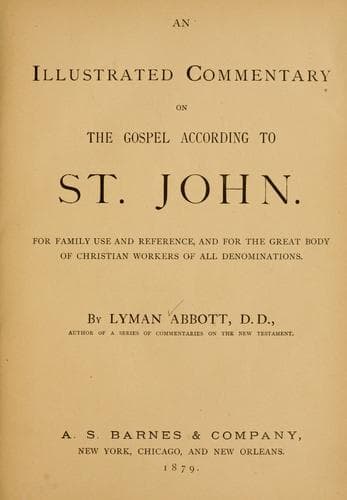
An illustrated commentary on the Gospel according to St. JohnAbbott, Lyman
Religion
An illustrated commentary on the Gospel according to St. John
Abbott, Lyman
Bible. John -- Commentaries
=2. Its literary character.= The differences between this Gospel and
the other three which I have already very briefly described, are
very considerable. They have led different minds to very different
conclusions respecting the authorship of the Fourth Gospel. It is,
however, safe to say that they are just such as might be expected if
the Fourth Gospel was written after the other three, and by some one
familiar with them, or at least with the traditions embodied in them.
This Gospel presents precisely the aspect which would be presented by
a book written for the purpose of supplementing the accounts already
possessed by the primitive churches, and of portraying an aspect of
character not adequately portrayed by the earlier writers. It presents,
too, exactly that aspect which would be presented by a narrative
written after the rapid growth of the Church, and its prophetic
incursions into heathenism had given the writer a better conception
than his co-disciples possessed of the spiritual character of the new
religion. Matthew, Mark, and Luke might perhaps have believed that
the privileges of Christianity were to be confined to Jews and Jewish
proselytes. Though many of Christ’s words which they report indicate
a broader scope, it is by no means clear that they comprehended them.
But no one can doubt that the author of John’s Gospel, when he wrote,
believed that the atonement of Jesus Christ was for all humanity, his
religion for all classes, races, and conditions of mankind. It is the
Fourth Gospel which tells us that He was the true Light which lighteth
_every man_ which cometh into the world, that God so loved the _world_
that he gave his only beloved Son that whosoever believeth in him
should have everlasting life, and that _whosoever_ comes to him he will
in no wise cast out; it is the Fourth Gospel which reports Christ’s
interview with the woman of Samaria and his subsequent preaching to the
Samaritans, which brings out more clearly than either of the others
the grounds of Christ’s practical abrogation of the Pharisaic law of
the Sabbath, which dwells more than any other Gospel on the spiritual
aspects of his kingdom and the divine nature of the king.[16] All this
we might expect from one writing after more than half a century of
Catholic Christianity had interpreted the nature, mission, and words of
Christ to his church.
Public-domain text, read in full here on John Shaqi.
Reviews
Reviews
No reviews yet
Be the first to share your thoughts on this work.
Join the Discussion
Join the discussion
Sign in to leave a comment or review.
Sign InorCreate an account