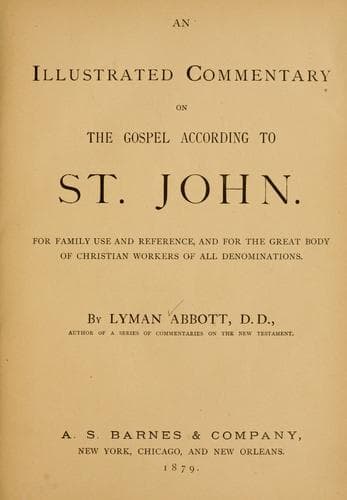
An illustrated commentary on the Gospel according to St. JohnAbbott, Lyman
Religion
An illustrated commentary on the Gospel according to St. John
Abbott, Lyman
Bible. John -- Commentaries
Let us add that a forger would not have suffered his narrative to stand
in such a marked contrast with the previous and recognized narratives
already in the possession of the churches. He would have commingled the
ethical with the doctrinal, the human with the divine. He would have
repeated in a modified form some of the incidents and teachings already
reported by the other Evangelists, that he might thus give a color of
authenticity to his narrative. The very contrast between the Fourth
Gospel and the other three, on which skeptic writers rely to prove
its untrustworthiness, is an indication that it cannot be the work of
fraud. If that aspect of Christ’s character and teachings reported by
John’s Gospel was not recognized by the primitive church as true, or if
the author was not himself known in the age in which the narrative was
produced, and so known that his simple name was a sufficient guarantee
of the accuracy of his narrative, an account so dissimilar from those
already in the possession of the churches would have received little
credit and no general, certainly no universal, acceptance.
=3. Indications of authorship.= A further examination of this Gospel
gives a definite impression respecting the character of the author.
He is evidently thoroughly familiar with Jewish manners and customs.
He knows whereof he writes. He has lived in the country and mingled
with the people. His knowledge is not that of a student of books, nor
that of a mere casual traveler. But he writes for those who are not
familiar with Palestine or its social life. He inserts parenthetical
explications of Jewish customs. He explains to his Gentile readers the
use of the firkins of water at the wedding-feast “for purifying after
the manner of the Jews;” the wrapping of the body of Jesus, as the
manner of the “Jews is to bury;” the refusal of the Pharisees to enter
Pilate’s hall “lest they should be defiled.” The feast of Tabernacles
is the Jews’ feast of Tabernacles, the Passover is the Jews’ Passover,
and the Preparation for it is the Preparation of the Jews.[17] These
references are so incidental as to indicate a writer thoroughly
familiar with Jewish life; yet they are so marked as to indicate
equally clearly a writer whose readers were not Jews but Gentiles.
Public-domain text, read in full here on John Shaqi.
Reviews
Reviews
No reviews yet
Be the first to share your thoughts on this work.
Join the Discussion
Join the discussion
Sign in to leave a comment or review.
Sign InorCreate an account