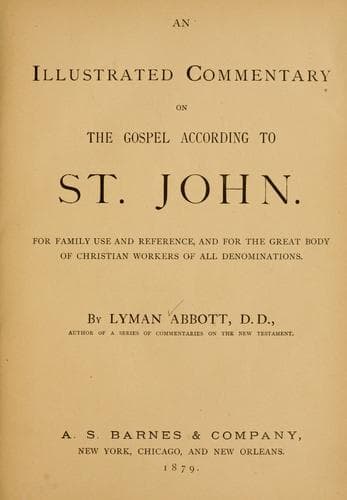
An illustrated commentary on the Gospel according to St. JohnAbbott, Lyman
Religion
An illustrated commentary on the Gospel according to St. John
Abbott, Lyman
Bible. John -- Commentaries
=30, 31. What therefore doest thou as a sign that we may see and
believe thee?= This response of theirs brings out the contrast between
faith and belief. Christ has said, Believe in him whom God hath sent;
the people, recognizing his reference to himself, reply, Why should
we believe you? or, as Norton renders it, “give you credit.” He calls
for an affectionate and confiding belief in his person and work, they
decline to give him simple credence.--=What dost thou work?= This is
not, as Maurice seems to interpret it, the language of a spiritual
yearning, but, as Alford, Stier, Meyer, the language of unbelief and
opposition, a sarcastic retort of his own words. “Thou commandest
us,” say they, “to work; what dost thou work thyself?” This demand,
coming so soon after the feeding of the five thousand, has given
rise to some perplexity, and rationalistic commentators cite it as
an evidence that no such miraculous feeding took place. If not, why
should the people refer to the manna? The fact is that, though the
five thousand were fed, no explanation was made to them of the way in
which the food was provided; they were commanded to take their seats;
the barley cakes, the bread of the poorest peasantry, were distributed
among them; they were doubtless astonished; but no conclusions were
drawn for them, and they were not in the habit of drawing conclusions
for themselves. When, therefore, on the Sabbath, Christ met in the
synagogue some of those who had been fed, together with others who
had not been present, nothing was more natural than this demand,
impliedly for both a repetition and an explanation of the miracle.
This is the significance of the reference to the O. T. account of the
miracle of the manna, “He gave them bread from heaven to eat” (Ps.
78:24). It was as if they said, The Psalmist has explicitly pointed
out the way in which the commission of Moses was confirmed; leave
us not in the dark respecting the feeding of the multitude, which
was, indeed, strange, but which has not been interpreted.--There is
also implied a contrast between the work of Moses and the work of
Christ; the manna came down from heaven, the bread was distributed
upon the earth; the manna was given day by day as needed for forty
years, the bread had been given but once; the manna was a sweet and
delicate food, “the taste of it like wafers with honey” (Exod. 16:31),
and it was among the rabbinical prophecies that the Messiah would
cause manna to descend which would please all tastes, “bread for the
young men, honey for the old, oil for the children;” but the bread
which Christ had distributed was barley bread, the commonest fare of
the poorest people.
32 Then Jesus said unto them, Verily, verily, I say unto
you, Moses gave you not that bread from heaven; but my[221]
Father giveth you the true bread from heaven.
[221] Gal. 4:4.
33 For the bread of God[222] is he which cometh down from
heaven, and giveth life unto the world.
Public-domain text, read in full here on John Shaqi.
Reviews
Reviews
No reviews yet
Be the first to share your thoughts on this work.
Elsewhere in the archive
Join the Discussion
Join the discussion
Sign in to leave a comment or review.
Sign InorCreate an account