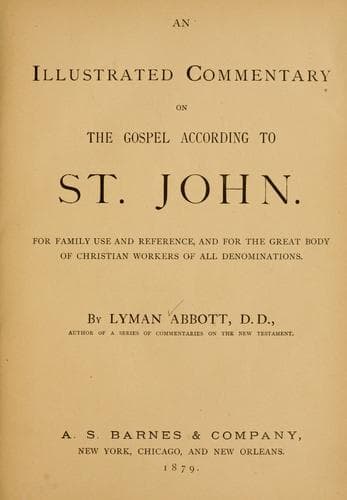
An illustrated commentary on the Gospel according to St. JohnAbbott, Lyman
Religion
An illustrated commentary on the Gospel according to St. John
Abbott, Lyman
Bible. John -- Commentaries
[222] verses 48, 58.
=32, 33. Verily, verily, I say unto you, not Moses gave to you that
bread from heaven; but my Father is giving you that which is the true
bread from heaven.= The people have referred to the manna as the
authentication of Moses; though they do not in words refer to him, the
spirit of their response is analogous to that of ch. 4:12, Art thou
greater than our father Jacob? Compare ch. 8:53. To this Christ
replies (1) that Moses did not give the manna; it was given by God;
Moses had nothing to do with bestowing it; the Israelites found it in
the morning after the dew had dried off the ground (Exod. 16:4, 14).
(2) This manna was not the true bread, but merely a type or shadow of
the spiritual antitype; so the Red Sea, the rock, the brazen serpent,
were mute prophets of spiritual verities, to be fulfilled through
Christ (ch. 4:14, 15; 1 Cor. 10:1-11). (3) Hence, the bread of God was
not a past, historic gift fulfilled in the days of the wilderness, but
a present and a perpetual gift, which the Father is ever giving. The
practical contrast suggested is that between the faith which reveres
only a past religion, a providence and an inspiration in the days of
the patriarchs and prophets and apostles, and that which holds fast to
a present providence, an ever-living Spirit, and a continuous
inspiration, a living bread ever given throughout all ages.--=For the
bread of God is that which comes down from the heaven and gives life
to the world.= Christ here lays down a general principle in which he
defines the essential characteristics of God’s spiritual gift. That
alone is the true bread (1) which is evermore descending from the
heavens, a perpetual bestowment; (2) which bestows life; (3) which is
for the world. The manna did not last over a single day (Exod. 16:19,
20), and finally ceased to fall when the Israelites entered the Holy
Land (Josh. 5:12); they that ate it all died (ver. 49); and it was
given only to a single nation. The type was brief in its duration,
limited in its effects, confined to a few recipients. The antitype is
for all mankind, confers everlasting life, and is bestowed evermore.
34 Then said they unto him, Lord, evermore give us this
bread.
Public-domain text, read in full here on John Shaqi.
Reviews
Reviews
No reviews yet
Be the first to share your thoughts on this work.
Elsewhere in the archive
Join the Discussion
Join the discussion
Sign in to leave a comment or review.
Sign InorCreate an account